Leverage is Cheap, Exits are Expensive


As of late 2026, curated DeFi vaults managing leveraged yield positions hold more deposits than some regional US banks. Yet much of this wealth is functionally a mirage.
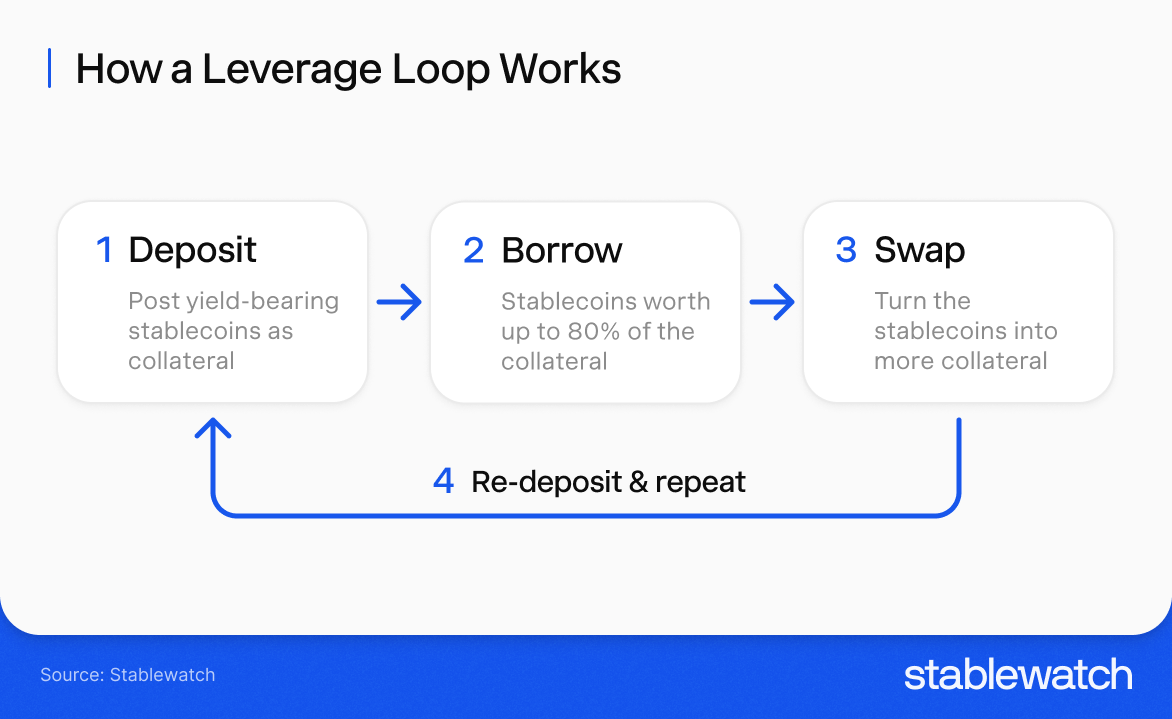
The strategy known as looping is a high-octane automated carry trade. An investor takes their equity, say $10 million in a yield-bearing asset, and posts it as collateral, borrows stablecoins against it, and uses those stablecoins to buy even more of the original asset. By repeating this cycle, they can push leverage to the brink, rapidly swelling a $10 million initial investment into a $50 million position backed by $40 million in stablecoin debt.
For protocol issuers, looping acts as a magical growth mechanism. It manufactures an asset supply that reporting figures rarely distinguish from genuine, unlevered deposits. But this manufactured supply could be the least sticky capital on an issuer’s books. Because loopers act as the ecosystem's marginal borrowers, their aggregate demand dictates the cost of funding. This leveraged capital exists only for as long as borrowing rates stay low, setting the stage for a balancing act where survival relies entirely on the size of the exit door.
While it is a brilliant maneuver to increase trade size, the loop also has structural flaws. When borrow rates spike, the trade’s margin rapidly vanishes. Suddenly, a position carrying $40 million in short-term debt becomes a race against time. Surviving such a shock rarely comes down to the fundamental credit quality of the underlying assets, but rather whether the position can be exited fast enough. This introduces duration risk, a hurdle that DeFi must overcome if it ever hopes to absorb traditional credit markets. Ultimately, the system's resilience depends on a key metric Arrakis calls Total Unwind Capacity: an illiquid asset's ability to clear an exit queue before an automated engine liquidates it.
How a Loop Actually Works
A leveraged yield position operates through a specific four-step progression. An investor posts collateral, borrows a stablecoin against it, swaps the borrowed stablecoins back into the yield-bearing asset, and redeposits that asset to increase the collateral base. Each iteration adds the product of the Loan-To-Value (LTV) ratio and the previous deposit to the total position size. Repeating this cycle creates a geometric sum that converges toward a theoretical ceiling: the initial equity multiplied by the inverse of one minus the LTV limit. This geometric progression allows a modest initial principal to control a multiple of its value in yield-bearing assets, funded entirely by short-term stablecoin debt.
Levered returns equal the asset yield multiplied by leverage, minus the borrow rate on the accumulated debt. Generating a positive net return requires sufficient principal to outpace infrastructural expenses, establishing a firm lower bound on viable position sizes. Small capital allocations remain structurally unprofitable in this framework because gas is a fixed, chain-dependent cost that drags on gross returns during network congestion. Slippage and AMM fees further reduce the net yield realized by the user upon executing the swap leg of the cycle. A user executing this strategy must ensure the spread between asset yield and borrow cost at least covers these fixed operational tolls.
The construction differs significantly when collapsing these multiple steps into a single executable transaction. Morpho lets users open a leveraged position in one transaction, either via callbacks that credit the collateral before the borrow or via fee-free flash loans, so the position opens instantly at its target leverage without third-party borrowing costs. Aave lacks a native one-transaction deposit mechanism for loops, forcing users to rely on external aggregators and its native, paid flash loans to bridge execution gaps. While a flash loan only checks that the money is returned at the very end of the process, the lending platform checks your collateral the exact moment you take out the loan, dictating exactly how automated execution paths must be engineered across different lending architectures.
The Spread Is the Whole Business
Loop profitability relies entirely on a carry trade in which external cash flow must exceed the cost of liabilities. At higher leverage multiples, the breakeven borrow rate converges toward the asset's yield, compressing the margin of safety. A 9% asset levered to the 11.8x ceiling of a 91.5% LLTV market, a position liquidatable on open, requires a breakeven borrow rate of 1.09x the yield, flipping to negative carry at roughly 9.8%. On the live PT-sUSDS markets, headroom was 191 basis points at 5x and 119 at 10x when the debt is USDC, but only 6 basis points at 5x and minus 66 at 10x when the debt is USDT. Before the position scales, the prevailing borrow rate is the baseline, but because loopers act as the marginal stablecoin borrower, aggregate loop demand ultimately dictates the funding cost.
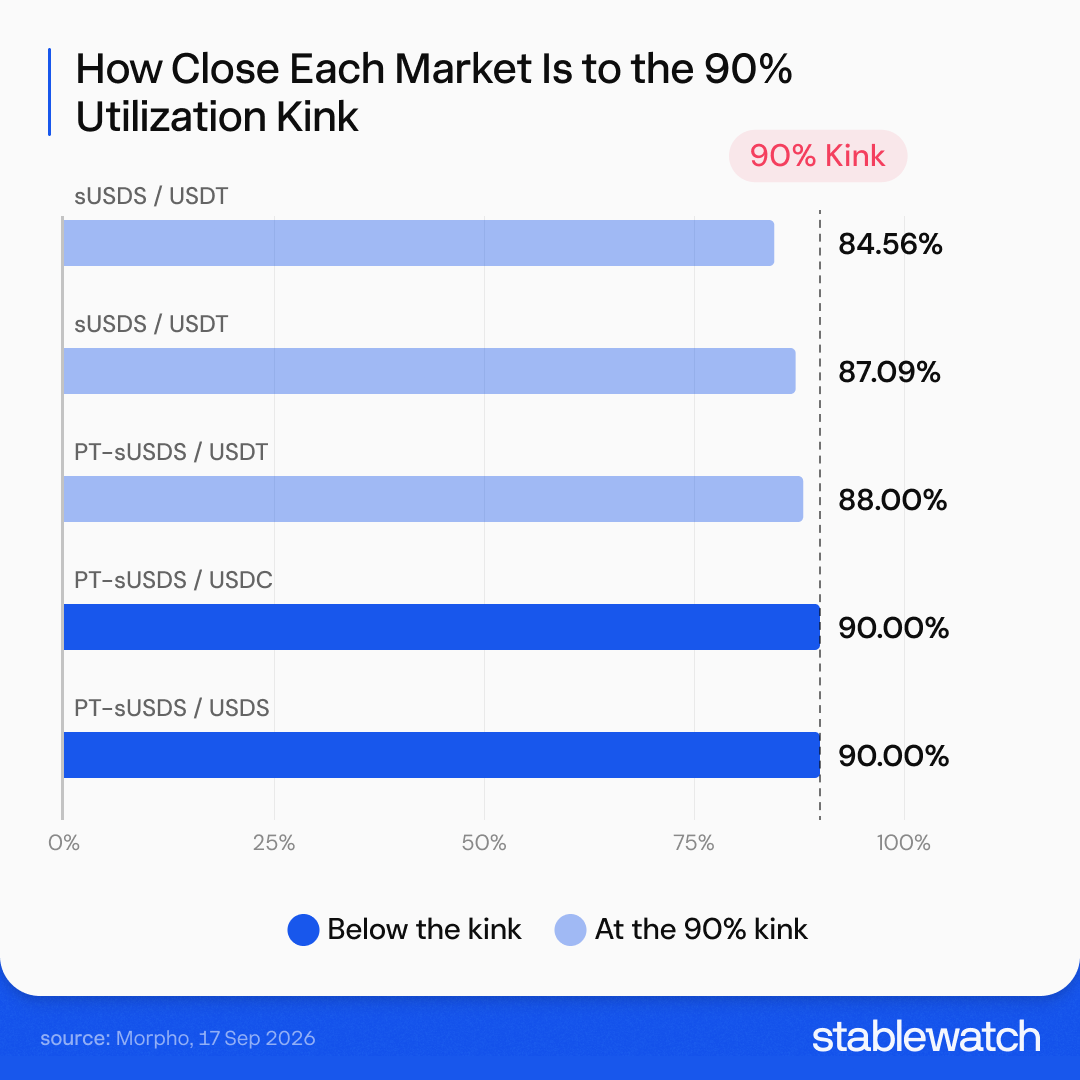
Funding costs can destroy these thin margins rather than waiting for collateral prices to fall. Morpho's Adaptive Curve interest-rate model (IRM) pushes the rate up continuously whenever utilization climbs above its 90% target, requiring no collateral price move to invert the trade. A supply-side withdrawal that pins utilization at 100% forces an immediate jump. Because the IRM only bites above the target, the mechanism severely punishes persistent pinning. Measurements of the PT-sUSDS/USDT market show that a mere $0.7 million withdrawal would pin utilization at 100%.
Rate distributions explain part of why private credit passes the carry filter while tokenized treasuries do not. Sovereign yields sit at the low end of the onchain rate distribution by construction because the DeFi base borrow rate is set by leverage demand. Treasury wrappers therefore tend to earn at or below the cost of borrowing against them in any market where loopers act as the marginal borrower. Sky’s sUSDS token shows how thin this carry is: a loop on it pays only while stablecoin borrow costs stay below the Sky Savings Rate.
One crucial counterweight sits outside all of these carry calculations: points and promotional incentive programs. These campaigns often provide the actual marginal carry that sustains the position. Consequently, a points program's expiration date functions as a scheduled, predictable negative-carry event and the clearest leading indicator of an impending unwind.
When the Loop Became a Product
Industrializing the looping user experience required fragmenting the operational process into three distinct infrastructural layers. Yield aggregation websites function as the top funnel, systematically aggregating disparate yield opportunities across highly fragmented isolated markets. Execution constructors operate below this layer, building the complex multi-transaction logic needed to enter a leveraged position while minimizing gas overhead. Wrapped vault products complete the stack by packaging the entire sequence into a single, composable deposit token. Segmenting the workflow lets specialized teams optimize specific friction points, but it also obscures the underlying mechanical risk from the end user.
Execution reality frequently contradicts marketing claims regarding seamless access. Pendle markets heavily advertise one-click execution pathways, yet the underlying onchain process lacks true atomicity. Leverage accumulates sequentially across multiple separate transactions routed through various execution networks. Smart contracts must borrow, swap, and redeposit capital in distinct, observable steps. Consequently, positions remain live and liquidatable during the intermediate blocks. Network congestion or sudden price volatility during this window could trigger liquidations before the intended loop even finishes forming.
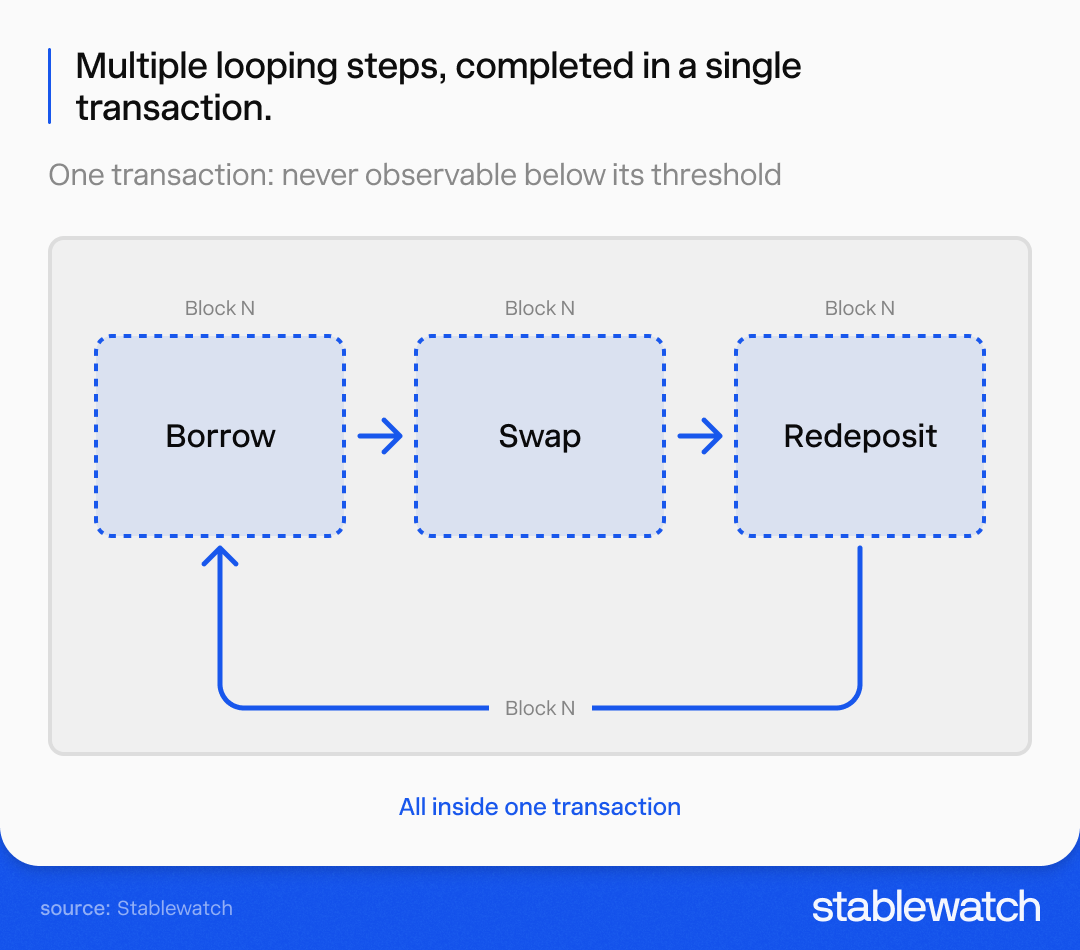
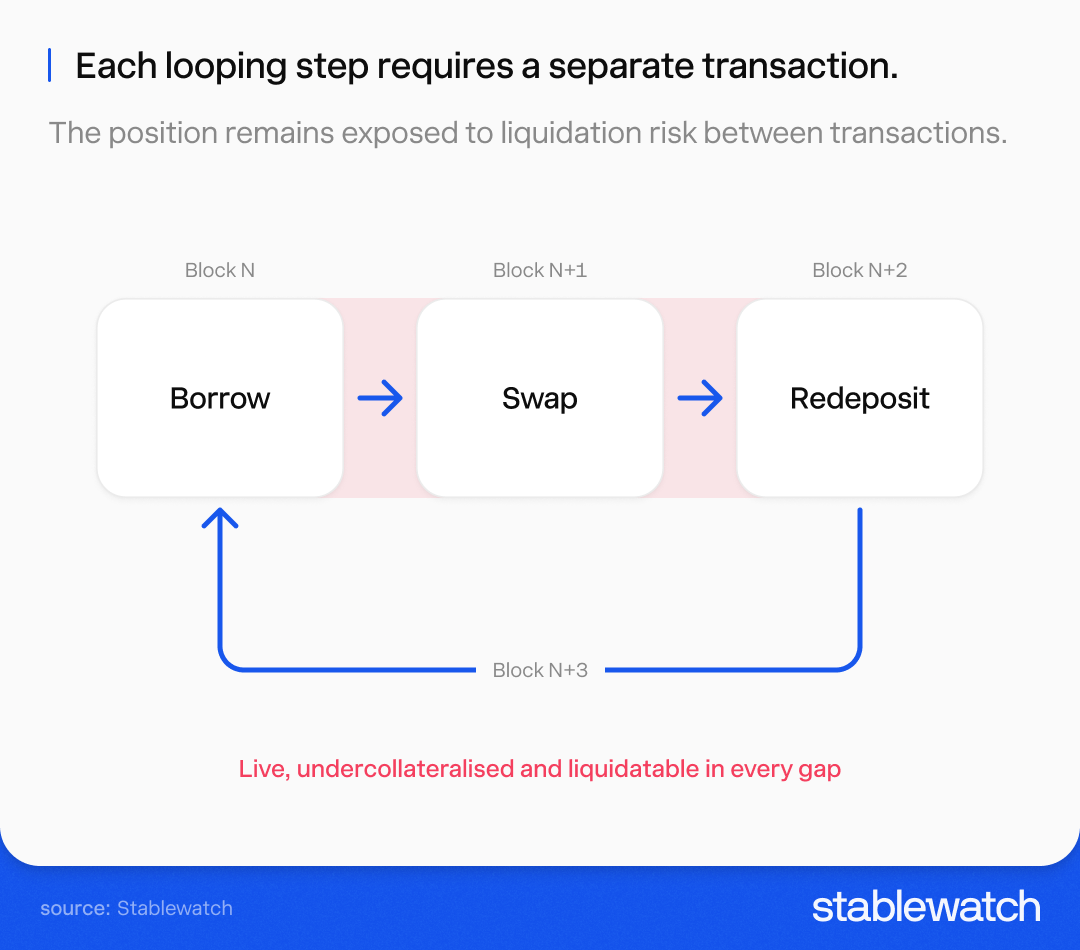
Hidden operational parameters dictate the actual risk profile buried within these automated user experiences. Custody structures deliberately separate debt management functions from collateral access rights. Users possess the unencumbered capability to repay borrowed stablecoins independently at any moment. Conversely, collateral withdrawal strictly requires manual intervention from a designated third-party executor. This asymmetry introduces asynchronous settlement risk into a highly leveraged position. Should the execution layer suffer an outage, users remain capable of clearing their debt but are operationally barred from reclaiming their underlying assets.
Valuation frameworks add further, less-obvious mechanical drag on the position's profitability. Five distinct, cascading layers comprise the oracle stack governing these specific PT assets, compounding the potential points of failure. Pricing takes the lower of a linear discount model and the Pendle AMM price, so whenever the discount binds, the lending system values collateral deterministically by time to maturity rather than at the tradable market price. This structural divergence often forces the protocol to recognize collateral at a significant discount to its spot value, artificially suppressing borrowing capacity. Furthermore, the fundamental profitability of the loop trade is constantly compressed by dynamic interest rate curves. As pool utilization scales, the resulting gross carry is squeezed into notoriously thin margins; with recent market snapshots showing gross carry of +62 basis points where the debt is USDC and -123 where it is USDT. Liquidation incentives remain similarly constrained by this tight margin, appearing potentially too marginal to reliably attract necessary third-party participation during violently distressed market conditions.
Exit Liquidity Poses a Greater Risk Than Leverage
Total Unwind Capacity strictly determines the true operational boundaries of onchain leverage. Arrakis analytical frameworks define this critical metric as the sum of atomic primary-redeem capacity and accessible secondary market depth, specifically priced at Net Asset Value. This combined liquidity profile must exceed the largest plausible simultaneous unwind event to maintain structural solvency during a crisis. Relying solely on historical daily volume underestimates the necessary buffer, as leveraged positions inherently correlate user behavior, guaranteeing that capital flight will occur simultaneously rather than sequentially.
Interest rate spikes demand immediate, same-block atomicity to successfully prevent cascading liquidations. Mismatches existing between highly liquid liabilities and illiquid assets introduce insolvency vectors into the ecosystem. Market evidence shows that a quarterly redemption window with a standard 30-day notice period can theoretically expose levered capital to up to 122 days of exit friction. Borrow rates can adjust every block during this waiting period, silently eroding the entire equity buffer while the user remains contractually locked into the position.
Same-block mint and redeem mechanisms utilizing AMMs anchor the highly liquid, low-risk end of the asset universe. Moving progressively outward along the risk curve, seven-day governance cooldowns introduce notable settlement lag into capital transitions, fracturing the atomic guarantee. Quarterly redemption offers with no liquid secondary market sit at the most restrictive end. Lenders financing positions at this edge transition from executing secured loans to underwriting duration risk.
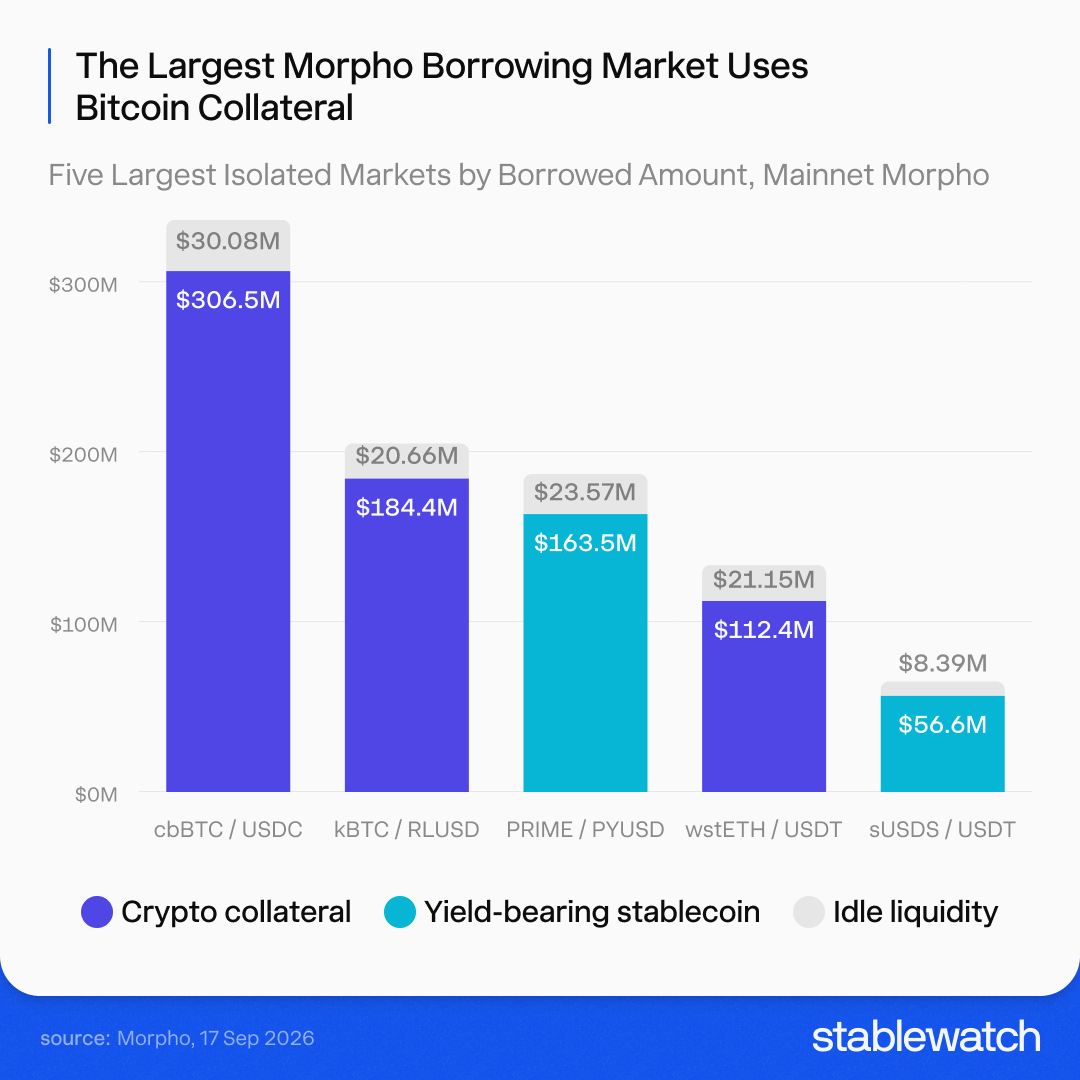
Capital flows currently reflect a distinct preference for highly liquid collateral types over fundamentally superior credit. Excluding Aave from the analysis because its pooled collateral model prevents attributing specific collateral to specific debt, the largest isolated-market leveraged position currently sits on cbBTC, which is not a yield loop at all, rather than on a yield-bearing real-world asset. Traders consistently prioritize the capacity to exit a position instantly over the theoretical safety of underlying treasury bills or corporate credit, directly validating the primacy of liquidity in setting leverage ceilings.
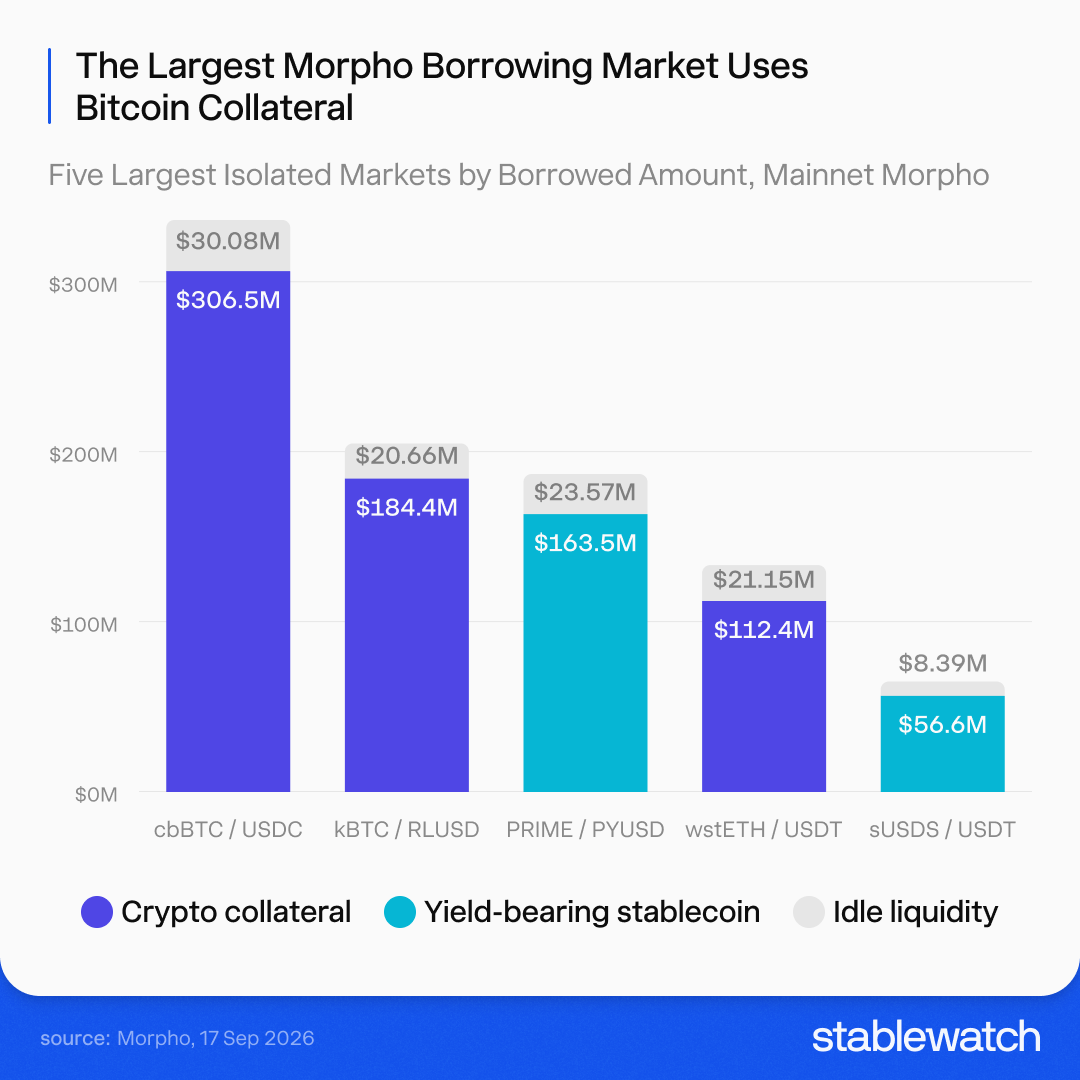
Mainnet Morpho data illustrates this exact disparity between asset classes operating on identical rails. Across nine distinct tokenized treasury wrappers, attributable loop borrow volume is zero, with a single exception: Spiko's EUTBL carries $2.7 million of borrow against EURCV. Identical isolated lending infrastructure successfully supports a robust, nine-figure borrow book for private credit collateral derivatives. Market participants systematically reject looping sovereign debt when the yield differential fails to justify the operational friction associated with the asset's redemption mechanics.
Binary asset-class distinctions fail to explain the zero-borrow phenomenon entirely. Private credit instruments such as JAAA and ACRED carry little or no attributable loop debt, alongside government debt. Transferability and concrete exit capacity operate as the actual discriminators dictating leverage adoption, explicitly overriding fundamental underlying credit quality. Market participants demonstrate a willingness to finance lower-tier credit possessing immediate secondary liquidity while completely ignoring AAA-rated instruments constrained by rigid regulatory whitelists.
However, analysis of wJAAA provides the sharpest counter-evidence to the pattern described so far. Carrying a 98% LLTV (the parameter that on Morpho serves simultaneously as the borrow cap and the liquidation threshold), it represents the most aggressive lending structure in the entire sector, implying a nominal 50x leverage ceiling on a tokenized AAA CLO fund. That ceiling is an asymptote rather than an attainable position: reached exactly, it describes a loan liquidatable in the block it opens. Despite supporting this massive theoretical multiplier, the asset offers very thin exit capacity, maintaining merely $0.42M in idle liquidity alongside a weak clearing incentive. This specific market directly inverts the expectation that strict liquidity constraints inherently limit allowable leverage.
Four Unwinds and One That Held
DeFi looping systems fail through three distinct channels: exit-capacity shortfalls, governance and oracle design flaws, and hidden counterparty concentration. Acknowledging this diversity of failure modes prevents the error of attributing all leveraged collapses to a single liquidity constraint.
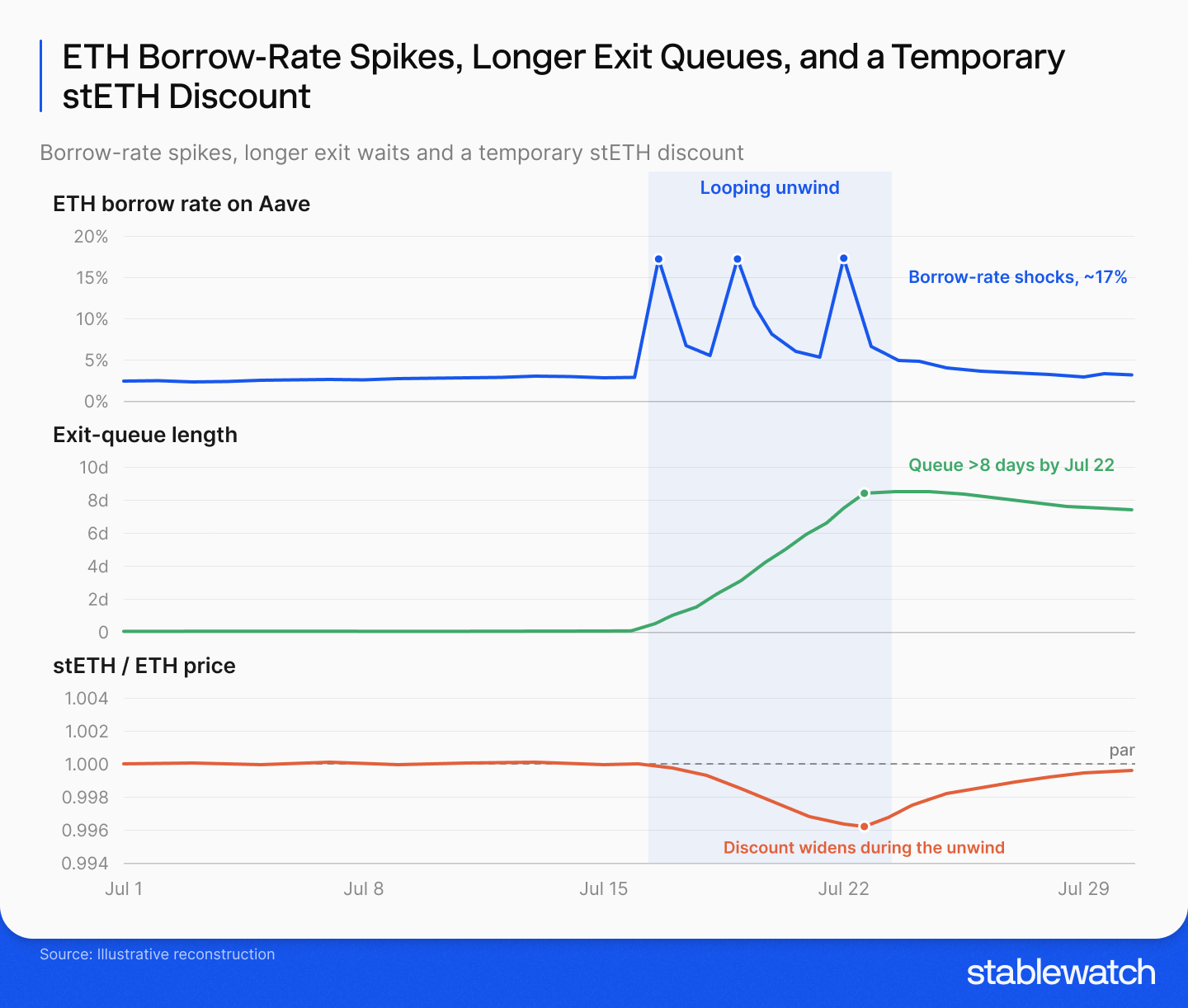
July 2025 delivered the clearest exit-capacity failure since stETH became redeemable, through the massive wstETH/ETH loop on Aave. A $1.7B withdrawal violently spiked borrow rates and inverted the underlying trade's carry. Loopers absorbed sustained, compounding losses while trapped entirely inside a days-long validator exit queue. Underlying network mechanics prevented users from unwinding positions fast enough to halt the bleeding, perfectly illustrating how settlement lag destroys leveraged equity during a rate shock.
January 2025 introduced a distinct failure mode driven by governance and oracle-design errors during the USD0++ episode. Protocol developers executed a sudden, unannounced structural change to the asset's fundamental redemption mechanics. This shift collided with a hardcoded $1 oracle on Morpho: because the repricing never reached the oracle, borrowers there were not liquidated, and lenders were trapped instead as utilization hit 100%. On the Chainlink-priced market, positions were liquidated, and because those liquidations were absorbed by redeeming USD0++ at $1, liquidated borrowers exited at better prices than unlevered holders who kept the distressed asset.
November 2025 on the other hand, witnessed a traditional credit event driven entirely by hidden counterparty concentration. Devastating collapses across Elixir deUSD and Stream Finance revealed that an external fund manager had lost $93 million of Stream’s assets, while Elixir had lent $68 million to Stream, roughly 90% of deUSD’s remaining backing. Contagion spread rapidly as this concentration risk materialized, triggering massive cross-protocol exposure and driving total systemic failure across deeply intertwined leveraged debt positions. Liquidity mechanics played no primary role; the underlying collateral was impaired at its source.
The market-wide liquidation cascade of 10th October 2025, three weeks earlier, demonstrated that identical mechanical lending structures can survive severe, coordinated stress. Maple reported that redemptions totalling $67M cleared through the protocol without triggering a single forced liquidation or registering any loss of user principal, a figure the firm published itself and no third party has audited. Machinery held perfectly firm when the underlying credit remained fundamentally sound and redemption pathways remained unencumbered by offchain friction.
April 2026 provided the best example of an exit-capacity collapse via the catastrophic rsETH bridge exploit. An attacker posted unbacked rsETH on Aave and borrowed WETH against it, driving WETH utilization to 100% and leaving less than $20 of idle WETH in Aave’s pooled Core market. Roughly $6.2 billion, some 23% of Aave's total value locked, was withdrawn from Aave, and lenders who had not exited in time could not. The event perfectly isolates the danger of absolute liquidity depletion.
Historically, no tokenized fund or private-credit token used as loop collateral has ever faced forced liquidation into a slow-redemption asset under live distress conditions. This structural resilience stems primarily from a fundamental lack of scale rather than superior underlying design. RWA collateral has simply rarely been looped with sufficient aggregate volume to severely test the hard boundary of its documented exit capacity during a genuine systemic crisis.
Who Is Lending the Dollars
Mainstream stablecoin borrowers pay 4 to 4.5% a year to fund looped positions. Aave v3 Ethereum USDC markets charge about 4.4% while paying suppliers about 3.7%. Borrowing against exotic collateral costs between 4 and 8.1%, reflecting the additional liquidation risk lenders assume.
Retail consumer deposits increasingly fund this senior leg. Robinhood Earn, announced in July 2026, routes retail USDG deposits into a Steakhouse-curated Morpho vault on Robinhood Chain. On Ethereum mainnet, curated vaults of the same kind already lend against looped collateral: Steakhouse’s USDT vault carries $5.6 million against spot sUSDS, in one of the markets the packaged loop products borrow in.
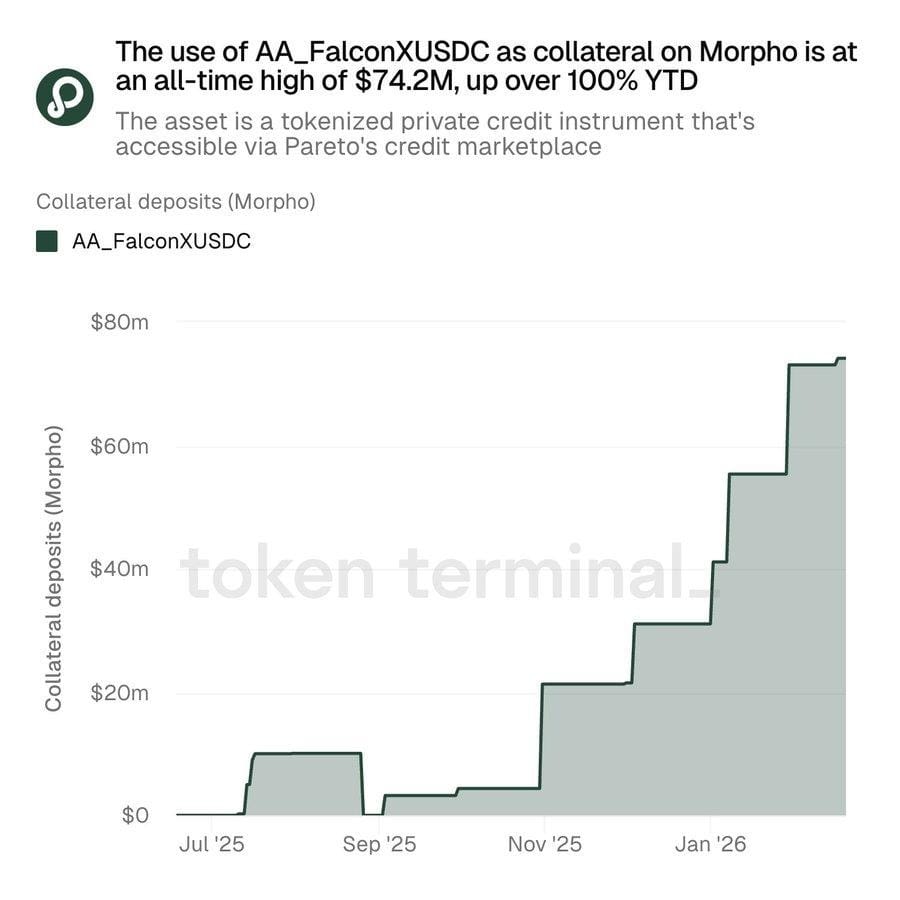
Identifiable institutional lenders supply the leverage for the large private credit loops. FalconX's credit-vault token backs $34 million of Morpho debt across two markets as of 24 November. Onchain data of the original AA_FalconXUSDC market (77% LLTV, $5.9 million borrowed) show Gauntlet accounts for 76% of the market's $6.7 million in supplied liquidity, with $1.2 million allocated through its USDC Frontier vault and $3.9 million through its USDC RWA vaults. The larger market lends against wFalconX, a wrapper holding AA_FalconXUSDC one-to-one, at a 91.5% LLTV with $28.1 million borrowed; there, Steakhouse-curated vaults supply 83% of the $32.2 million in liquidity, led by 3F x Steakhouse USDC at $14.2 million and Steakhouse High Yield USDC at $10.6 million.
A distinct curator layer sets the risk parameters for onchain credit. Vault counts offer a poor metric for this sector, as only 79 of Morpho’s roughly 1,400 listed V1 vaults held more than $1 million (Morpho also lists about 3,900 V2 vaults). Revenue concentration reveals the market's true shape, with just three firms taking 78.3% of all vault earnings, as measured in August 2026.
Competition over this thin margin pushes curators out on the risk curve. Managing a vault requires $285 to $385 million in assets to break even on a measured 5.2 to 5.6% revenue margin. Only about six curators on Morpho clear that threshold. Firms lacking blue-chip scale differentiate by listing loopable exotic collateral to attract deposits.
At the same time, liquidation incentives offer thin compensation for seizing illiquid collateral. Morpho's liquidation incentive factor provides a 1.1 to 2.6% bonus across the 91.5% to 96.5% LLTV band, dropping to 0.6% at 98%. The thinnest compensation sits precisely where the leverage is highest; the lower thresholds most private credit carries, between 77% and 86%, pay a more workable 4.4 to 7.4%. Liquidators facing these margins must act as duration warehouses for assets they cannot sell immediately, increasing the likelihood that a bad position remains unliquidated.
Three substitutes exist for this duration warehousing: NAV-aligned AMMs, swap lines, and solver auctions. These simply offer different prices and inventory models for transferring duration risk from the looper to an underwriter. A liquidator executing against a queue-redeemed asset must pre-fund the debt repayment and hold the collateral throughout the settlement window. This dynamic shifts liquidation from a risk-free arbitrage into a duration warehousing business. Every evaluated exit rail is new, operates with thin liquidity, and faces a classic bootstrap problem. These products price exit duration, but they don't provide the balance sheet needed to absorb the inventory. None of these mechanisms has yet faced a correlated unwind where the warehouser actively rejects the collateral.
Industry Built Out of the Gap
CoinDesk research quantifies the magnitude of the settlement lag constraint. A quarterly redemption window combined with a standard 30-day notice period creates up to 122 days of exit exposure. A leveraged holder must survive funding rate volatility across this entire four-month window before retrieving their principal. Standard DeFi tools fail against this structural delay. Flash loans require atomic settlement within a single transaction. Asynchronous RWA wrappers settle over days or weeks, rendering the entire flash-loan ecosystem incompatible with this collateral class.
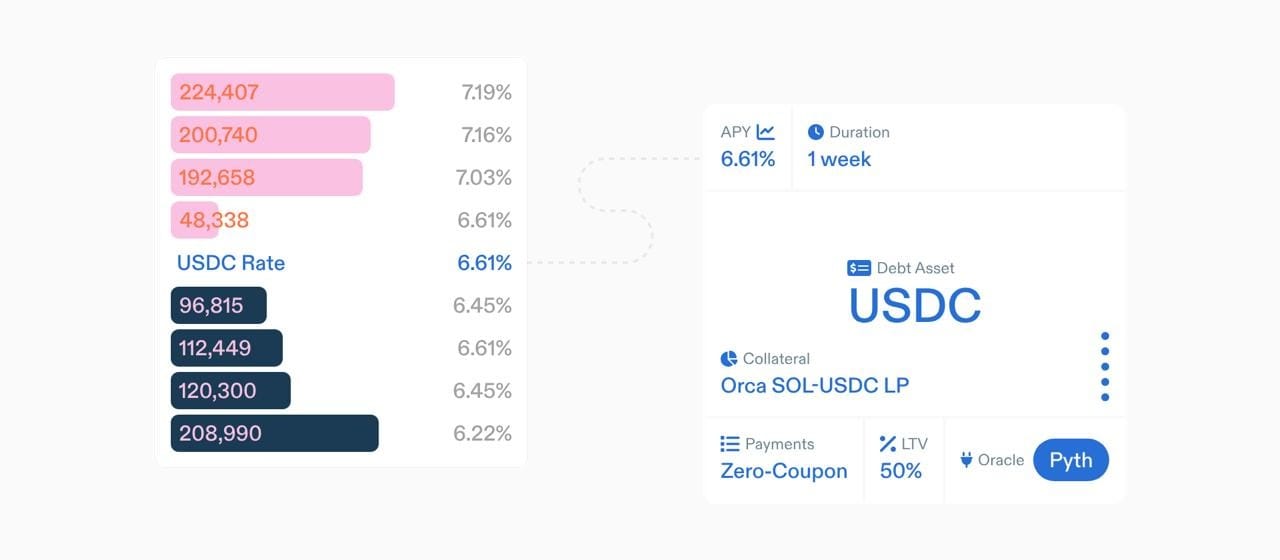
3F, a protocol built specifically for leveraged RWA positions, addresses this gap by replacing the flash loan with a Bridge Facilitator. This actor fronts capital during the settlement lag, pricing risk through request-for-quote (RFQ) offers. The protocol settles the transaction by minting its own principal and yield tokens, letting users enter a leveraged position without managing the intermediate steps.
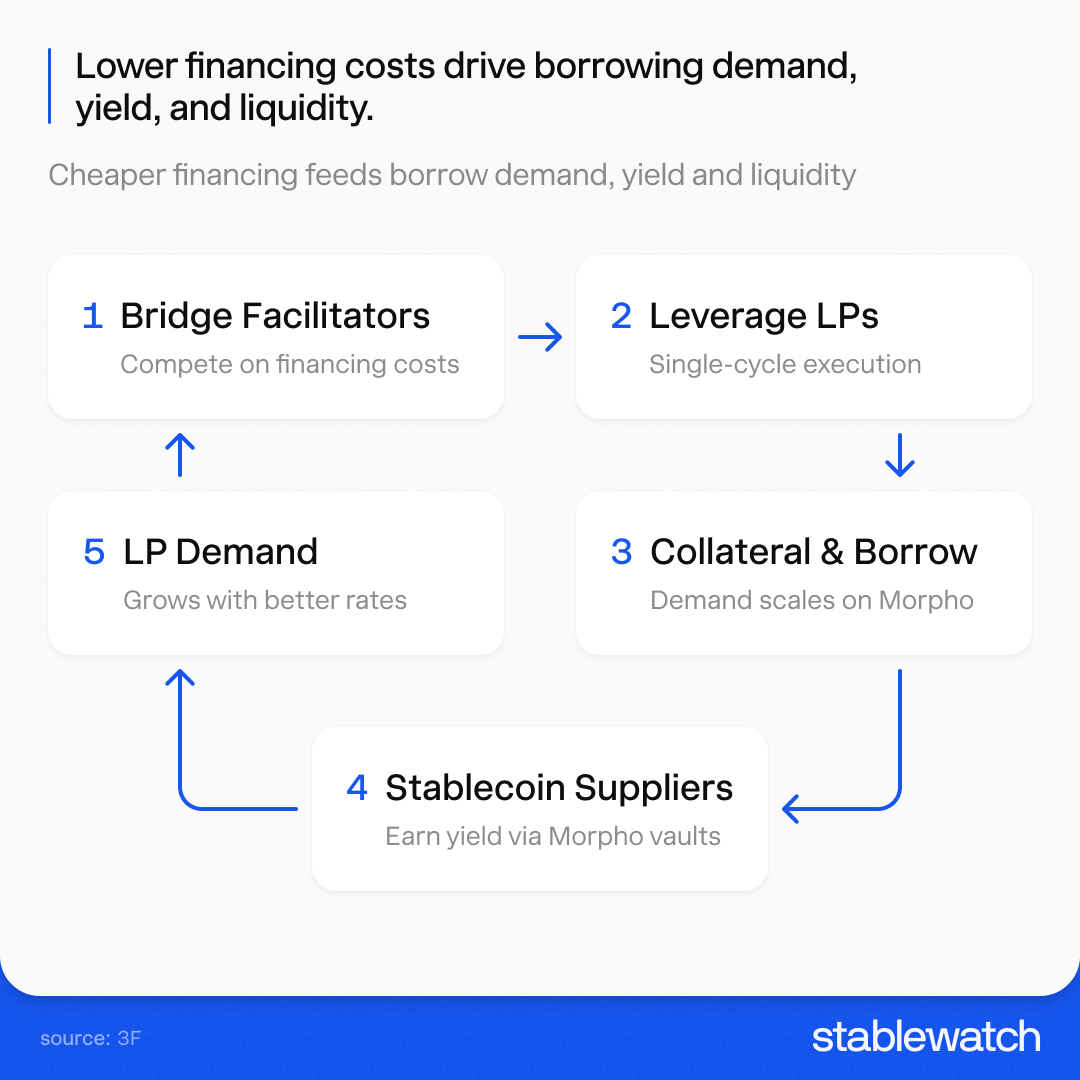
A layered liquidation threshold mechanism governs the 3F architecture. Each position carries its own safe and liquidation thresholds, both set at or below the Morpho market’s LLTV, so the position becomes actionable inside 3F before it becomes unhealthy on Morpho. This gap acts as an economic haircut on illiquid collateral, mirroring the discipline traditional repo desks use to manage settlement risk.
Keyring and FalconX built another architecture by internalizing the settlement delay upstream. Zero-knowledge KYC processes clear the compliance gate, rendering the resulting receipt token fully transferable. Onchain data confirm that $34 million in borrow volume sits behind this transferable token as of 24 November: $5.9 million in its 77% LLTV market and $28.1 million in a 91.5% LLTV market against its wrapped version, wFalconX. That is down from roughly $54 million in late September, when the 77% market alone carried $32.8 million.
Keyring demonstrates why transferability matters: non-transferability is the zero-bound case of Total Unwind Capacity: an asset only a whitelisted party may hold possesses zero secondary depth by construction, so its unwind capacity is whatever the primary redemption queue will bear and nothing more. Transferability, exit depth, and the carry spread are the three explanations that, together, determine which assets get looped. Senior lenders fund this FalconX exposure onchain. Gauntlet's vaults supply most of the original market and Steakhouse-curated vaults most of the wrapped one, closing the loop on who provides the leverage for the RWA.
Loopscale built a third architecture that targets rate volatility and settlement lag. The protocol structures fixed-rate loans with automatic refinancing, matching borrowers directly with lenders, and its PRISM product handles delayed settlement and issuer redemption for permissioned assets. This design addresses the floating-rate kill switch that historically inverts the carry on these positions.
Three independently funded teams have built architectures around the gap; all three targeted the settlement lag, one also the adjacent rate volatility, but none discloses the annualized cost of bridging it. That three separate teams raised capital against the same constraint is evidence the constraint is real. It is not yet evidence that any of their answers work, and each account here remains the vendor's own.
What Repo Already Solved
Traditional finance manages structures similar to looping through the repurchase agreement market, posting a yield-bearing security as collateral to secure cash, using that cash to purchase additional securities, and repeating the process. Managing this leverage requires strict haircuts, margin-call discipline, and limits on rehypothecation. Repurchase agreements represent TradFi’s equivalent to onchain looping, directly addressing the risks of borrowing against collateral that cannot be liquidated instantly.
Repo haircuts serve as the required buffer between the collateral's market value and the cash advanced against it, absorbing mark-to-market volatility and liquidation costs. The Office of Financial Research found in 2025 that over 60% of non-centrally-cleared bilateral Treasury repo runs at a zero haircut, while 10% of all outstanding repo in that segment ran at a negative haircut. Dealers use position limits, netting agreements, and portfolio-level margining instead of strict haircut percentages, so haircut size alone understates the true risk buffering in institutional markets.
Atomic onchain liquidation contrasts sharply with repo's deliberately multi-day close-out procedures. Counterparty defaults under the Global Master Repurchase Agreement trigger immediate margin recall, but non-defaulting parties have until the fifth dealing day under the widely used 2000 GMRA to determine Default Market Value. Dealers use actual sale proceeds, dealer quotes in commercially reasonable size, or explicit mark-to-model estimates when collateral proves illiquid. No atomic primary-redemption equivalent exists within traditional repo architectures, ensuring liquidators are not forced to dump assets into a frozen market.
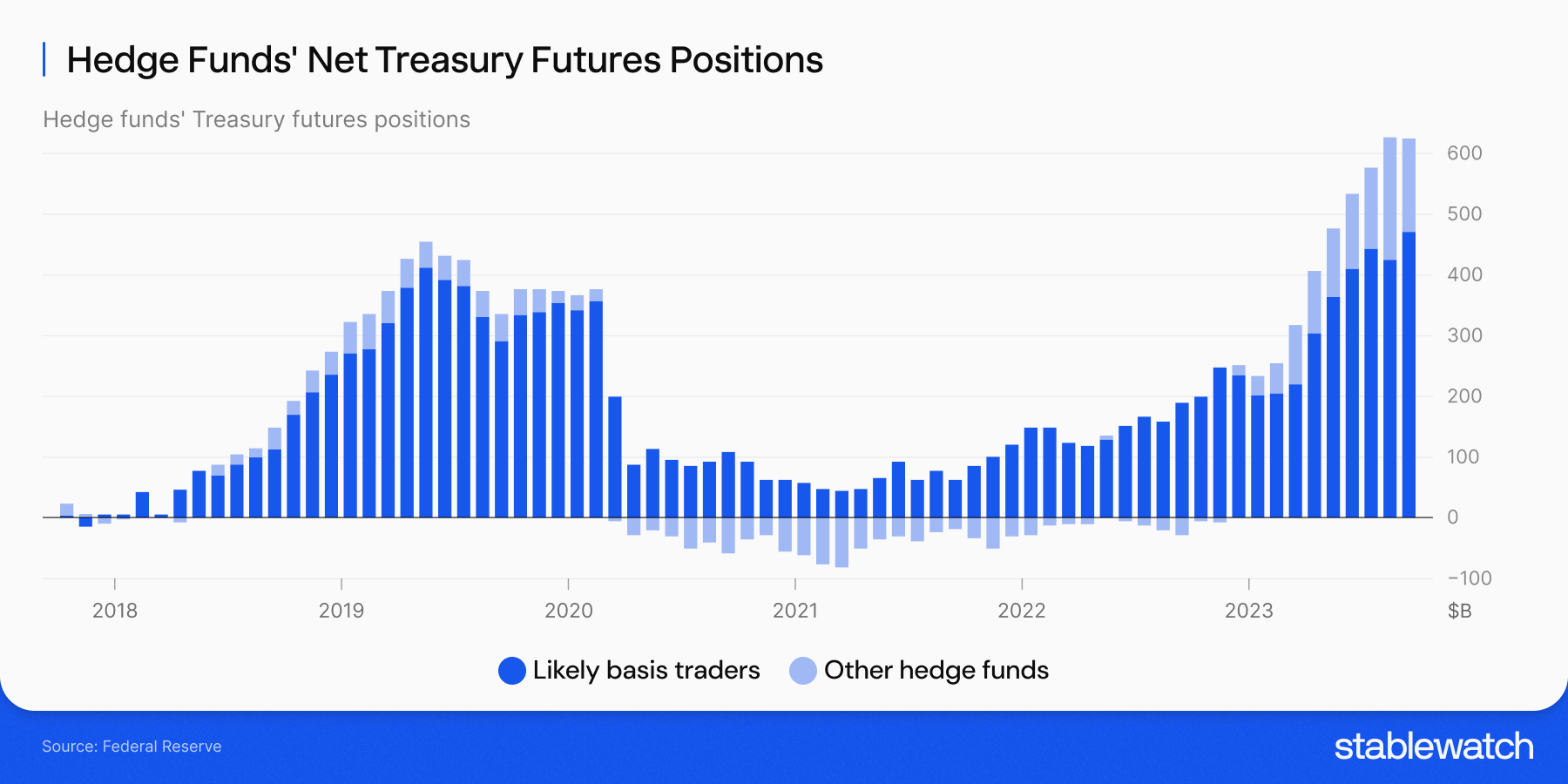
March 2020 provided the clearest TradFi instance of a safe asset failing strictly on its funding leg. Hedge funds trading the Treasury basis faced simultaneous tightening from two independently set margin systems: futures margin requirements and dealer-set repo haircuts. Leveraged portfolios unwound rapidly under this dual pressure, selling an estimated $91 to $105 billion in Treasuries and accelerating a sell-off in which credit quality played no part, though the OFR researchers behind the estimate judge the basis trade unlikely to have been its primary cause.
Money market fund regulations implemented in 2016 represent a completed natural experiment regarding static liquidity gates. Fund boards could gate redemptions entirely if weekly liquid assets fell below a 30% threshold. The prospect of gates, together with a floating share price for institutional prime funds, drove more than $1.1 trillion out of prime and municipal funds in 2016, most of it before the October deadline. Regulators removed the gates entirely in 2023, replacing them with a mandatory liquidity fee for institutional prime and tax-exempt funds on days when net redemptions exceed 5%. This regulatory history maps directly onto RWA tokens carrying notice-period redemptions.
Bilateral rehypothecation limits offer protections that DeFi lacks. SEC Rule 15c3-3 caps collateral reuse at 140% of a client's debit balance, protecting a single client against one specific prime broker. DeFi operates with open-market recursive reuse, possessing no depth limit and no clean traditional finance precedent. Borrowed collateral flows across systems with no contractual visibility into each other's aggregate exposure, allowing leverage to compound recursively across the ecosystem.
The One Treasury Yield That Does Get Looped
Apart from EUTBL, the tokenized treasury wrappers named earlier carry no material loop debt on Morpho. Morpho API snapshots from September 23, 2026, show that sUSDS breaks this pattern, with a $20.3 million borrow book against PT-sUSDS-26NOV2026 collateral in third-party stablecoins: $13.1 million in USDC and $7.2 million in USDT. A separate market facilitates a distinct $2.1 million same-asset loop borrowing spot USDS against PT-sUSDS. The analysis focuses on isolated-market venues, explicitly excluding Aave because pooled collateral cannot be attributed to specific debt.
This specific market architecture cuts two ways regarding systemic viability. The findings are distinctly favorable to sUSDS looping potential because the asset successfully clears the exit gate and sustains leverage. Conversely, the market structure remains explicitly adverse on safety due to a rigid oracle design and reliance on a governance-set floating rate.

Governance votes at Sky setting the Sky Savings Rate propagate directly through the stack into the carry of levered positions on Morpho. Against the 3.6% base yield at the time (3.80% by late November), the principal token prices a 5.17% implied APY on Pendle. This implied APY forms the market's fixed-rate pricing for a floating, governance-controlled variable.
Oracle failover mechanisms on these markets fire only upon a USDS depeg exceeding 0.75% and arrive 16 hours late due to timelocks; until then, the collateral stays marked at its pre-depeg value. The primary oracle takes the lower of a 13%-per-year linear discount toward par and the Pendle AMM price. On September 23, the discount bound, marking the collateral 1.42% below its tradable price, which protects the lender and costs the borrower capacity. As with the 2016 money market fund gates, marking collateral above its exit price with a static or lagging valuation mechanism fails to reduce risk.
Onchain measurement, however, confirms that this specific principal-token loop is less exit-fragile than the preceding sections imply; it only partially fails, which makes the surviving part more credible. As of September 23, the asset carried a 64-day fuse to its 26 November 2026 maturity, at which point it redeems one-to-one and the discount mark converges to par independently of market action. The Pendle AMM pool held $7 million of liquidity, though pool TVL overstates what a seller of principal tokens can realize.
The Liquidity Limit of Decentralized Credit
Carry spreads select the collateral, but exit capacity caps leverage. Onchain liquidity dictates maximum multiples far more strictly than the fundamental credit quality of the underlying loans.
Historical events confirm that rate volatility and settlement lag break leveraged equity long before asset degradation occurs. Severe funding and exit-capacity failures drove losses in two of the five evaluated episodes. Leveraged yields fail through distinct mechanical channels rather than generic market downturns.
Consumer deposits increasingly fund the senior stablecoin leg of these trades, intermediated by vault curators actively competing on yield. These shifts push capital outward along the risk curve toward exotic collateral. Proposed infrastructural fixes like duration swap lines remain young, untested, and largely incapable of providing the balance sheet needed to warehouse risk during a systemic unwind.
Traditional finance precedents highlight the specific structural trade-offs decentralized infrastructure still navigates. Until unwind capacity per asset becomes explicitly measurable, fixed-rate liabilities scale to institutional depth, and curator disclosures standardize across the industry, the ecosystem relies on incomplete data. The loop remains a trade where the spread is advertised, but the exit capability is not.
Yield+ by Osero brings another iteration to solve these problems. It doesn't remove the constraint we described: the strategy needs time to unwind, and withdrawals aren't instant. What it does well is setting the three key decisions where a professional desk would. Collateral that redeems permissionlessly rather than by queue. Leverage that falls automatically when the spread turns, rather than waiting for a liquidator to arrive. An exit window stated in hours and published before it is needed, not discovered during the unwind. Yield+ by Osero is what it looks like when the exit is priced into the design instead of found out afterward.
SOURCES
- https://arrakis.finance/blog/looping-playbook
- https://www.cork.tech/blog/duration-risk-in-defi
- https://research.castlelabs.io/p/composable-tradfi-rwas-in-defi
- https://morpho.org/stories/steakhouse
- https://x.com/robdogeth/status/1956048702889406510
- https://castlelabs.io/research/reports/real-world-assets
- https://caladan.xyz/from-pools-to-vaults-the-21b-rwa-wave-reshaping-onchain-lending/
- https://www.esma.europa.eu/sites/default/files/library/esma34-39-897_guidelines_on_liquidity_stress_testing_in_ucits_and_aifs_en.pdf
- https://www.coindesk.com/research/the-rwa-yield-infrastructure-trade
- https://docs.morpho.org/learn/concepts
- https://pendlefi.substack.com/p/pendle-print-121
- https://morpho.org/blog/robinhood-chooses-morpho-to-power-new-earn-product
- https://morpho.org/blog/the-morpho-rwa-playbook-make-tokenized-rwas-productive-via-defi-lending/
- https://docs.3f.xyz/
- https://blog.loopscale.com/posts/
- https://www.theblock.co/post/398686/3f-morpho-funding-everaged-exposure-tokenized-assets
- https://www.coindesk.com/business/2024/03/19/crypto-compliance-platform-keyring-raises-6m-to-unlock-defi-for-institutional-investors
- https://maple.finance/insights/maple-performance
- https://docs.osero.org/osero-app/
- https://osero.org/blog/yield-is-live-in-the-osero-app-powered-by-gauntlet
- https://www.dlnews.com/articles/defi/defi-whales-trigger-mass-staking-unwind-after-withdrawing-ethereum-from-aave/
- https://www.theblock.co/post/364436/ethereum-validator-exit-queue-reaches-highest-point-ever
- https://governance.aave.com/t/staked-eth-and-aave-risk-june-11th-update/8469
- https://decrypt.co/104102/nansen-analysis-examines-how-terra-collapse-affected-celsius-and-three-arrows-capital
- https://leviathannews.substack.com/p/collateral-damage-usd0-depeg-leaves
- https://crypto.news/stablecoin-developer-usual-faces-backlash-after-changing-redeem-function/
- https://vaultbook.gauntlet.xyz/resources/market-volatility
- https://www.kucoin.com/news/flash/defi-hardcoded-oracle-vulnerability-repeats-for-fourth-time-in-14-months
- https://www.theblock.co/post/377491/analysts-map-285m-in-potential-exposure-across-defi-after-stream-finances-93m-loss
- https://www.theblock.co/post/377961/elixir-sunsets-deusd-synthetic-stablecoin-following-stream-finance-unwinding-aims-for-full-redemptions
- https://governance.aave.com/t/rseth-incident-report-april-20-2026/24580
- https://finance.yahoo.com/markets/crypto/articles/kelp-dao-exploit-sparks-aave-191220560.html
- https://www.coindesk.com/tech/2026/04/19/aave-records-usd6-billion-tvl-drop-as-kelp-hack-exposes-structural-risk-at-defi-lender
- https://governance.aave.com/t/rwa-market-recap/10888
- https://www.icmagroup.org/market-practice-and-regulatory-policy/repo-and-collateral-markets/icma-ercc-publications/frequently-asked-questions-on-repo/21-what-is-a-haircut/
- https://www.financialresearch.gov/the-ofr-blog/2025/08/12/are-zero-haircut-repos-as-common-as-advertised/
- https://tellerwindow.newyorkfed.org/2025/04/08/haircuts-in-treasury-repo-a-look-at-the-non-centrally-cleared-bilateral-repo-market/
- https://www.icmagroup.org/market-practice-and-regulatory-policy/repo-and-collateral-markets/icma-ercc-publications/frequently-asked-questions-on-repo/26-what-happens-to-repo-in-a-default/
- https://www.cliffordchance.com/content/dam/cliffordchance/briefings/2011/05/icma-publishes-2011-global-master-repurchase-agreement.pdf
- https://www.financialresearch.gov/working-papers/files/OFRwp-21-01-hedge-funds-and-the-treasury-cash-futures-disconnect.pdf
- https://resonanzcapital.com/insights/cash-futures-basis-repo-leverage-and-margin-an-allocators-guide-to-the-treasury-basis-trade
- https://www.fsb.org/uploads/P040226.pdf
- https://libertystreeteconomics.newyorkfed.org/2017/03/money-market-funds-and-the-new-sec-regulation/
- https://corpgov.law.harvard.edu/2023/08/22/the-secs-money-market-fund-reforms/
- https://www.klgates.com/Out-With-the-Old-in-With-the-New-SEC-Scraps-Swing-Pricing-Proposal-Removes-Redemption-Gates-and-Mandates-Liquidity-Fees-for-Money-Market-Funds-7-17-2023
- https://www.finra.org/rules-guidance/guidance/interpretations-financial-operational-rules/sea-rule-15c3-3-and-related-interpretations
- https://arxiv.org/pdf/2204.11107