Built-In Protection: How the Osero Earn Security Framework Protects Depositors

Any wallet, neobank, exchange, or custodian offering a savings product will face the same questions:
Where does the yield come from? How easy is it to access funds? And if something goes wrong, who takes the loss?
These questions are important because when markets are stable, most yield products seem alike. The real differences show up when liquidity dries up, investments lose value, or many users try to withdraw at once.
Osero Earn was designed to make it easy for platforms to offer stablecoin savings without sacrificing risk management.
The product brings together three main features: access to the Sky Savings Rate, a fully managed integration layer, and a risk management framework based on Basel III. This framework adds several layers of protection between investment losses and depositor funds.
This article will focus on the Osero Earn Security Framework.
We'll explain how losses are absorbed, how liquidity is managed during market stress, and how platforms can check these protections in real time.
Key Highlights
- With Osero Earn, platforms turn idle stablecoin balances into diversified yield while keeping depositor protection aligned with TradFi capital standards, such as the Basel III capital protection framework.
- Wallets, neobanks, exchanges, and custodians can stand out by offering the Sky Savings Rate along with multiple layers of capital reserves. This way, users earn yield, and businesses keep their risk under control.
- When partners use Osero Earn, they get access to a proven yield engine and can see live data on positions, liquidity, and risk capital.
The Foundation: Sky Savings Rate
Osero Earn is built on the Sky Savings Rate (SSR), which generates yield for sUSDS, the platform’s yield-bearing token.
The SSR comes from Sky Protocol's diverse balance sheet overseen by specialized managers called Agents.
The yield does not come from just one strategy. Sky Protocol spreads its capital across different asset classes:
This diversification means the yield is not dependent on a single source, and risk is distributed across a mix of onchain and institutional instruments.
Right now, there is $4.6B in sUSDS supply and $10.02B in total USDS supply.
Capital Protection
The Problem with Standard DeFi Yield
Most onchain yield products operate simply: users deposit their money, the protocol invests it, and if something goes wrong, depositors bear the loss. The protocol itself does not share in the risk.
Regulated financial systems take a different approach. Under Basel III, banks must maintain capital reserves that align with the risk of their assets. If a loan fails, the bank’s own capital covers the loss first. This protects depositors through the system, not just luck.
The Agent Framework
Allocations backing USDS and sUSDS are made by Agents, specialized economic actors authorized to borrow USDS from Sky Protocol to deploy capital across approved strategies. In exchange for that borrowing capacity, Agents are subject to strict capital requirements.
This is what sets Osero Earn apart from standard DeFi yield products.
Agents are not just middlemen; they have their own capital at stake and are directly affected by the performance of the positions they facilitate.
The Loss-Absorption Stack
The system is set up so that USDS holders are the last to take any loss.
There are four layers of capital reserves that absorb losses before USDS is affected. If losses go beyond these reserves, two backup recovery options are available as a last resort.
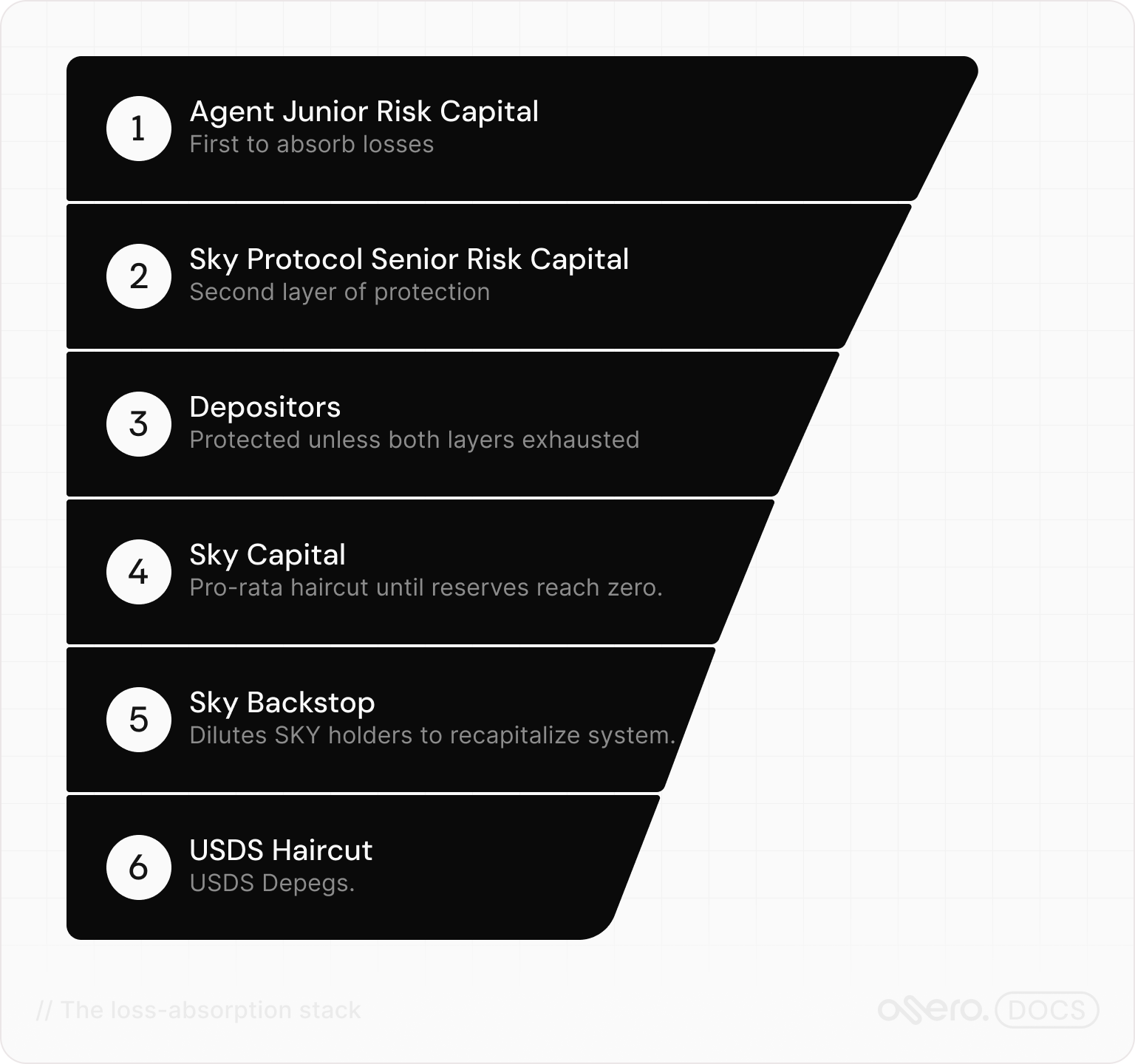
The loss absorption stack. Source: The Sky Frontier Foundation website.
Here’s how the process works:
- First, the Agent’s own First-Loss Capital absorbs any losses. Each Agent puts up its own capital alongside the assets allocated through it, meaning its capital takes the first hit if those allocations underperform.
- If losses go beyond the Agent’s own capital, the rest of the First-Loss Capital from all providers covers the next layer of losses.
- The Stability Capital Buffer is another layer of protection. It’s funded from Sky’s operating cash balance and is meant to absorb more losses before the protocol’s main capital is affected.
- Sky Capital is the last line of defense before depositors are affected. If all earlier layers are exhausted, losses are spread across Sky Capital until it is exhausted.
The system only moves to recovery mechanisms if all four capital protection layers are fully exhausted.
Those recovery mechanisms include:
- The SKY Backstop that can mint and sell SKY tokens to recapitalize the system.
- A USDS target-price haircut, considered the final recovery mechanism, in which USDS could temporarily trade below its target value while affected holders receive SKY token compensation.
The main point for depositors is simple: their funds are protected by several independent layers of capital before any losses can reach them.
Instead of relying on a single reserve or counterparty, the framework spreads loss absorption across dedicated capital providers, protocol reserves, and, if needed, system-wide recovery options.
Why This Matters
DeFi has seen many yield products that looked good at first but later failed. These losses often occurred because the systems lacked sufficient capital protection for depositors.
Basel III was created because regulators learned from years of banking crises. The main idea is simple: those who manage risk should have something at stake, and depositors should be the last to bear losses.
Osero Earn brings this principle onchain through multiple layers of protection: capital designed to absorb losses, mechanisms to support recovery under stress, dedicated liquidity, and real-time transparency into the system’s backing.
This is how risk management should be done.
Learn more about capital protection in the Osero docs.
Frequently Asked Questions
Why does Osero Earn focus so much on risk management instead of just yield?
Because yield only matters if it can survive tough times.
Many DeFi products can offer good returns when markets are strong. The real question is what happens when an investment underperforms, liquidity dries up, or markets get volatile. Osero Earn focuses on capital protection, liquidity management, and transparency because these are the systems that keep a savings product resilient over time.
What makes Osero Earn different from a typical DeFi yield product?
Most DeFi yield products pass investment risk straight to depositors. If a strategy loses money, user funds are usually the first to be affected.
Osero Earn uses a different model inspired by Basel III. Before losses can reach depositors, they must pass through four layers of capital reserves, starting with Junior Risk Capital from Agents, followed by Senior Risk Capital from Sky Protocol. Depositors are at the bottom of the loss stack, not the top.
Does this mean deposits are risk-free?
The goal of the risk framework isn’t to eliminate risk entirely, but to manage it through several layers of protection. For depositors to lose money, all four capital reserve layers would have to be used up first. This setup makes depositor losses much less likely than in traditional DeFi yield products.
Why is the Basel III comparison important?
Basel III was created after repeated banking crises demonstrated the importance of capital buffers and liquidity requirements.
Osero Earn operates onchain, but the core idea remains the same: those who manage risk should provide the capital, and depositors should be protected by multiple layers of loss absorption.