Built-In Liquidity: How Osero Supports Withdrawals

For any stablecoin savings product, one question matters as much as the yield: how easily can you get your funds back when you need them?
It sounds straightforward. If a product is fully backed, the money should be there. But having enough assets and having enough assets available right now are two different things.
A balance sheet can be healthy while much of its capital is deployed in positions that take time to unwind. Most of the time, that distinction barely matters. But it definitely starts to matter when markets move quickly, redemption demand rises, or many users want to withdraw at once.
Osero is designed around that distinction.
Alongside the layered capital protection structure behind the product, a dedicated portion of the collateral base is held in liquid assets to support withdrawals.
That liquidity is called Actively Stabilizing Collateral.
This article explains what sits inside it, how it fits into the broader system behind the Sky Savings Rate, and why it matters to Osero users.
Key Highlights
- Osero separates two questions that are often treated as one: what backs the system, and what is available to support withdrawals?
- The broader backing includes assets and positions with different liquidity profiles. A dedicated portion, called Actively Stabilizing Collateral, consists of assets available to support redemptions and help the system respond when market pressure increases.
- Its size and composition are not fixed. They change as capital moves across the Sky Ecosystem, and Osero provides visibility into the current backing and liquidity composition rather than presenting either as a static number.
Where the Yield (and the Liquidity) Come From
The Sky Savings Rate (SSR) is the rate earned by sUSDS, the yield-bearing token used by Osero. That rate is supported by income generated across Sky Protocol’s balance sheet, with capital allocated across different strategies and asset types.
This can include liquid stablecoin reserves, onchain lending markets, tokenized real-world assets, and other positions across the Sky Ecosystem. Each plays a different role. Some are highly liquid. Others are designed to generate returns over a longer period and may take more time to unwind.
That mix is part of what makes the distinction between backing and liquidity important.
The assets generating yield are not necessarily the same assets that can be immediately used to meet withdrawals. Looking only at total backing, therefore, tells you only part of the story.
Osero makes the underlying composition visible. Users can see the broad categories of assets backing the system, while the Liquidity view separately shows the portion associated with active liquidity support. The underlying positions, entities, and supporting documentation provide additional context on where the yield comes from and how the system is structured.
For a more detailed breakdown of Sky’s liquidity framework, methodology, and current liquidity position, see Sky’s Liquidity documentation.
Inside the Liquidity Layer: Actively Stabilizing Collateral
Backed Isn't the Same as Available
Imagine two savings products with exactly the same amount of backing.
One keeps a significant portion of its assets in positions that can be accessed quickly. The other has most of its capital tied up in positions that may take days to unwind.
On paper, both may be equally well backed. For someone trying to withdraw during a volatile market, they are not necessarily equally liquid.
This is why liquidity is treated separately from overall backing.
Osero tracks the portion of the collateral base available to support withdrawals, allowing it to distinguish between the total assets backing the system and those that can play an active role when liquidity is needed.
What Sits Inside the Liquidity Pool
Osero App’s Liquidity panel shows this portion of the system as Actively Stabilizing Collateral.
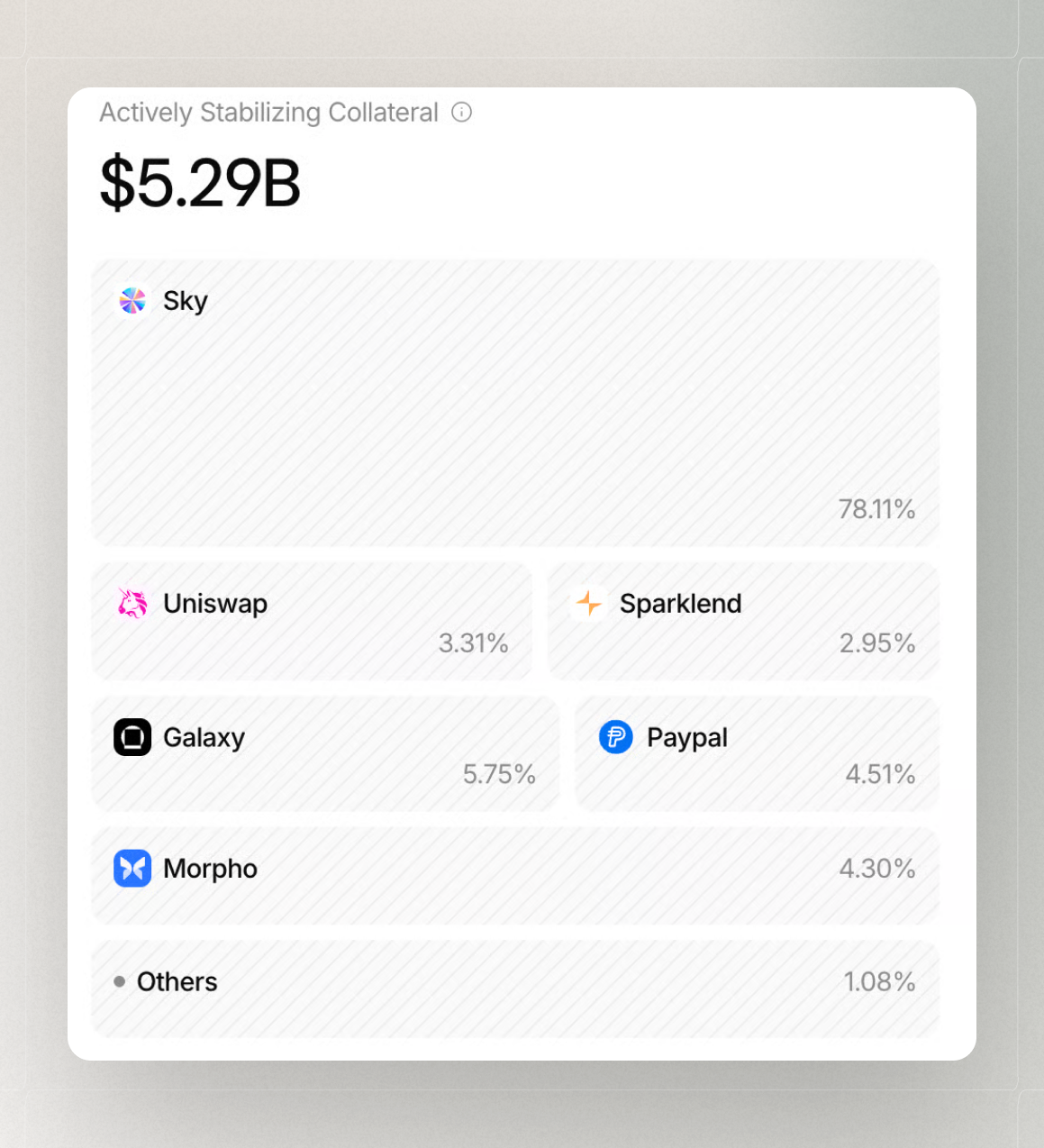
An example view of Actively Stabilizing Collateral. Source: Osero App.
It can include two broad types of assets: idle stablecoin balances and liquid onchain positions.
Idle stablecoins are funds that are not currently deployed into another position. Liquid onchain positions are deployed, but can be converted or unwound as conditions allow.
Neither should be confused with the system's entire backing. They represent the part specifically associated with active liquidity support.
Showing that number separately matters. Instead of asking users to infer liquidity from the size of the overall balance sheet, Osero gives them a direct view into the assets available to support withdrawals.
This Number Is Supposed to Move
Actively Stabilizing Collateral is not a fixed reserve sitting untouched in one place.
Its size and composition change as capital is allocated, withdrawn, matured, or rebalanced across the Sky Ecosystem. The liquidity picture can therefore look different from one period to another.
That is not necessarily a problem. It reflects that the underlying balance sheet is dynamic.
The same applies to individual assets within the liquidity layer. How quickly a position can be converted, and at what price, depends on the asset, market depth, available routes, network conditions, and the market environment at the time.
Liquidity is therefore better understood as a current state of the system than as a permanent promise about future execution.
When Redemption Pressure Builds
The difference becomes most visible when withdrawal demand increases.
Under normal conditions, users enter and exit savings positions without giving much thought to the balance sheet behind them. When markets become volatile, that changes. More users may want to withdraw at the same time, liquidity elsewhere in the market can become thinner, and assets can become harder or more expensive to unwind.
This is where Actively Stabilizing Collateral comes in.
By keeping part of the collateral base in assets that are already liquid or can be converted relatively quickly, the system has a dedicated liquidity layer available to respond to increased redemption demand.
This is also why liquidity and capital protection should not be treated as the same thing.
Capital buffers are designed to absorb relevant losses. Liquidity addresses a different problem: whether assets are available when withdrawals need to be met.
A system can have enough assets overall and still face liquidity pressure. Conversely, having liquid assets available does not protect against every potential loss. The two mechanisms address different parts of the risk picture.
Seeing What Sits Behind the Yield
Yield numbers are easy to display. Understanding what produces them is harder.
Osero App’s transparency views are designed to connect the rate users see with the system underneath it.
The Backing view shows the broad composition of assets supporting USDS and sUSDS, including categories such as liquid assets, lending positions, short-term debt, and other reported assets. The composition changes as the underlying portfolio changes.
The Liquidity view isolates Actively Stabilizing Collateral, allowing you to see which portion of that broader backing is associated with active liquidity support.
And the Protection view shows the capital buffers designed to absorb potential losses, including Junior Risk Capital held by Agents and Senior Risk Capital maintained by Sky.
Together, these views provide different perspectives on the same system: what generates and backs the savings position, what can support withdrawals, and what capital exists to absorb relevant losses.
The goal is not to turn a dynamic financial system into a simple promise. It is to make more of that system visible, so users and platforms can understand what sits behind the yield rather than evaluating the rate in isolation.
For related context, see Backing and Capital Protection in the Osero docs.
Why This Matters
Yield tends to get most of the attention in stablecoin savings. Liquidity often matters only when something goes wrong.
But a savings product needs both.
Users need to know that the assets behind their position exist. They also need to understand how much of that backing is positioned to support withdrawals when demand increases.
Traditional finance has treated solvency and liquidity as separate questions for decades for exactly this reason. An institution can have more assets than liabilities and still run into trouble if it cannot turn those assets into cash quickly enough.
Stablecoin savings face a version of the same problem.
Osero’s approach is to make that distinction explicit.
The broader backing shows what supports the system. Actively Stabilizing Collateral shows the liquidity layer within it. Capital protection provides another layer designed to absorb relevant losses.
None of these mechanisms make liquidity unlimited or guarantee execution under every market condition. But together, they give users and platforms a much clearer picture of what sits behind the savings product and how it is designed to respond when withdrawals increase.
For a savings product, that visibility matters just as much as the number next to the APY.
Frequently Asked Questions
Why does Osero show liquidity separately from total backing?
Because total backing and available liquidity answer different questions. Some assets can be accessed quickly, while others may take longer to sell or unwind. Showing Actively Stabilizing Collateral separately makes it easier to see which part of the collateral base is available to support withdrawals.
What counts as Actively Stabilizing Collateral?
It can include idle stablecoin balances and liquid onchain positions. Idle stablecoins are not currently deployed, while liquid onchain positions can be converted or unwound as conditions allow.
Is redemption instant and guaranteed at a set price?
No. Execution time and pricing depend on factors including the asset, market conditions, available routes, liquidity, and network activity. Quotes and fees are determined based on the conditions of each transaction.
How does liquidity help during periods of market pressure?
When withdrawal demand increases, Actively Stabilizing Collateral provides a pool of assets that can support redemptions without requiring the entire balance sheet to be unwound at once.
How can users see what sits behind the yield?
Osero separates the system into several transparency views. Backing shows the broader asset composition behind USDS and sUSDS, Liquidity shows Actively Stabilizing Collateral, and Protection shows the capital buffers designed to absorb relevant losses. Together, they provide context on where the yield comes from and how the system is structured.
Why does the amount of available liquidity change?
Because the underlying balance sheet changes. As positions are added, withdrawn, matured, or rebalanced across the Sky Ecosystem, the size and composition of Actively Stabilizing Collateral can change with them.