Robinhood Vault: Retail Lenders, Institutional Borrowers


Borrowing-Side Analysis of the Steakhouse USDG Vault on Morpho
Abstract. Robinhood Chain, and particularly the Steakhouse-curated Robinhood Morpho vault, has emerged as one of this year’s most notable DeFi launches. Within just one month, the vault reached $600M in TVL and originated $287M in loans, growing faster than comparable DeFi lending pools. The lender side is well understood: Robinhood’s 27 million users can deposit USDG through the app and earn a 7% APY. Until now, however, little has been known about the borrowers.
This report presents the first empirical analysis of the vault’s borrower base and how it has been bootstrapped with institutional allocators (>$1M positions). We identify 36 of them. Together, they account for 98% of the vault’s outstanding debt, while retail borrowing grows organically. These institutional allocators primarily pursue leveraged carry trades, with median leverage of 9.4× and a median health factor of 1.05. Such strategies can operate within a robust risk framework, but only after careful due diligence covering the chain, vault markets, collateral assets, and oracle design. This bootstrapping strategy helped the vault attract $324 million in collateral within its first 30 days.
1. Introduction
On July 1, Robinhood announced the launch of Robinhood Chain, an Ethereum Layer 2 designed for DeFi integration from day one. Unlike most new chains, Robinhood Chain launched with established protocols already deployed: Uniswap for secondary-market trading and Morpho for lending. The first vault established was the Steakhouse-curated USDG lending vault on Morpho. It accepts deposits in Global Dollar (USDG), a stablecoin issued by Paxos.
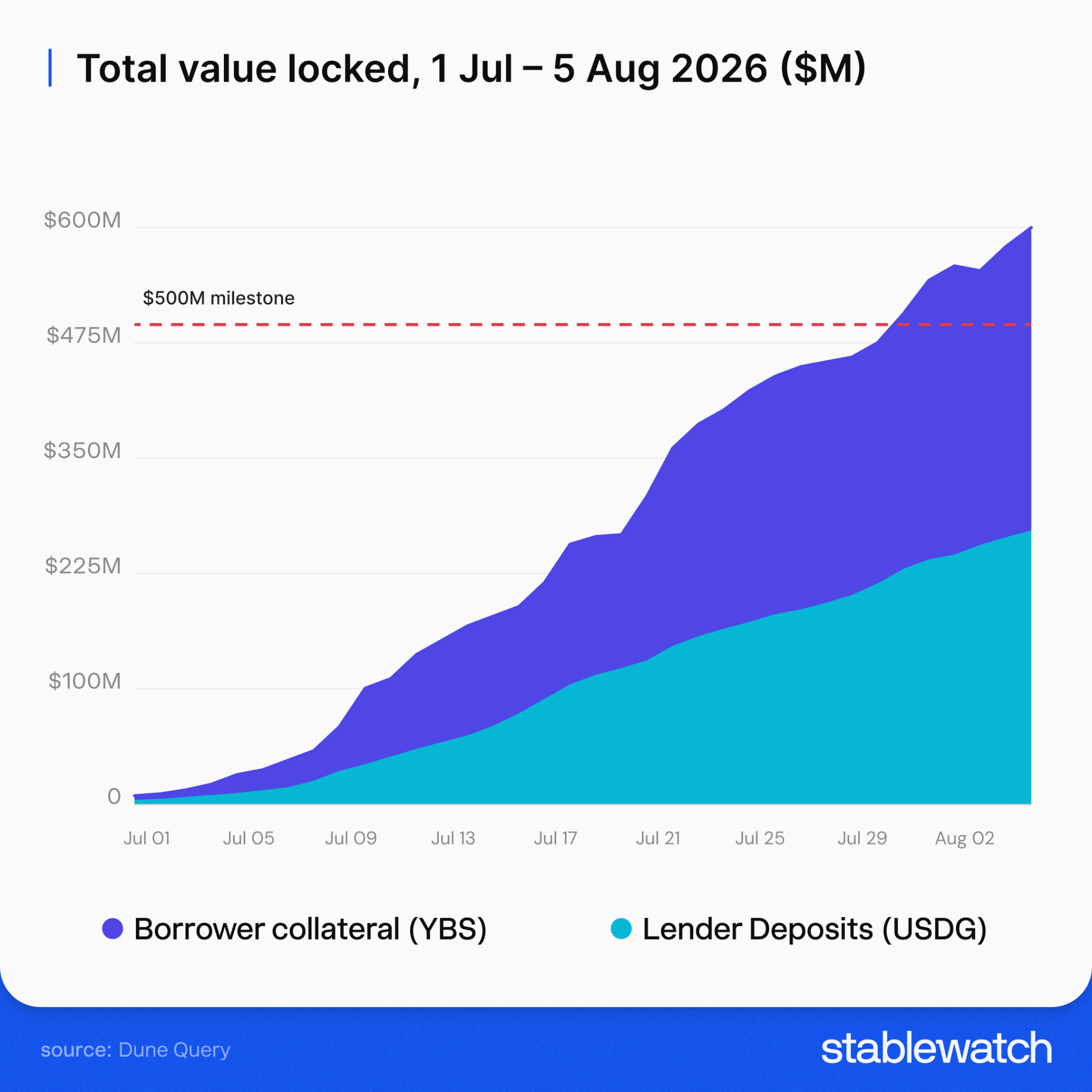
Within just 30 days, lender deposits reached $281 million, while borrowers supplied $324 million in collateral, bringing the vault’s total value locked above $600 million. The lender side is relatively well understood: Robinhood’s retail users deposit USDG and earn a 7% APY, supported partly by incentive programmes. The borrower side, however, has remained largely invisible.
Understanding the borrower side is essential to assessing the vault’s long-term sustainability. The current 7% yield is partly subsidised by incentives. Over time, however, the part of the vault’s yield must come from organic borrowing demand: borrowers willing to pay interest to borrow USDG against their collateral.
The vault currently allocates capital across three isolated markets: USDe/USDG, syrupUSDG/USDG, and spUSDG/USDG. The collateral assets-Ethena’s USDe, Maple’s syrupUSDG, and Spark’s spUSDG-are all denominated in US dollars, tradeable on Uniswap, and supported by deep liquidity ecosystems.
Steakhouse’s market selection reflects this focus on sustainable yield. To generate meaningful interest income, the selected markets must be capable of absorbing substantial USDG liquidity. The three collateral assets offer attractive economics through native yield, incentives, or both. Borrowers supply these tokens as collateral and borrow USDG to capture the spread between their collateral return and borrowing cost-a standard institutional carry trade executed on-chain.
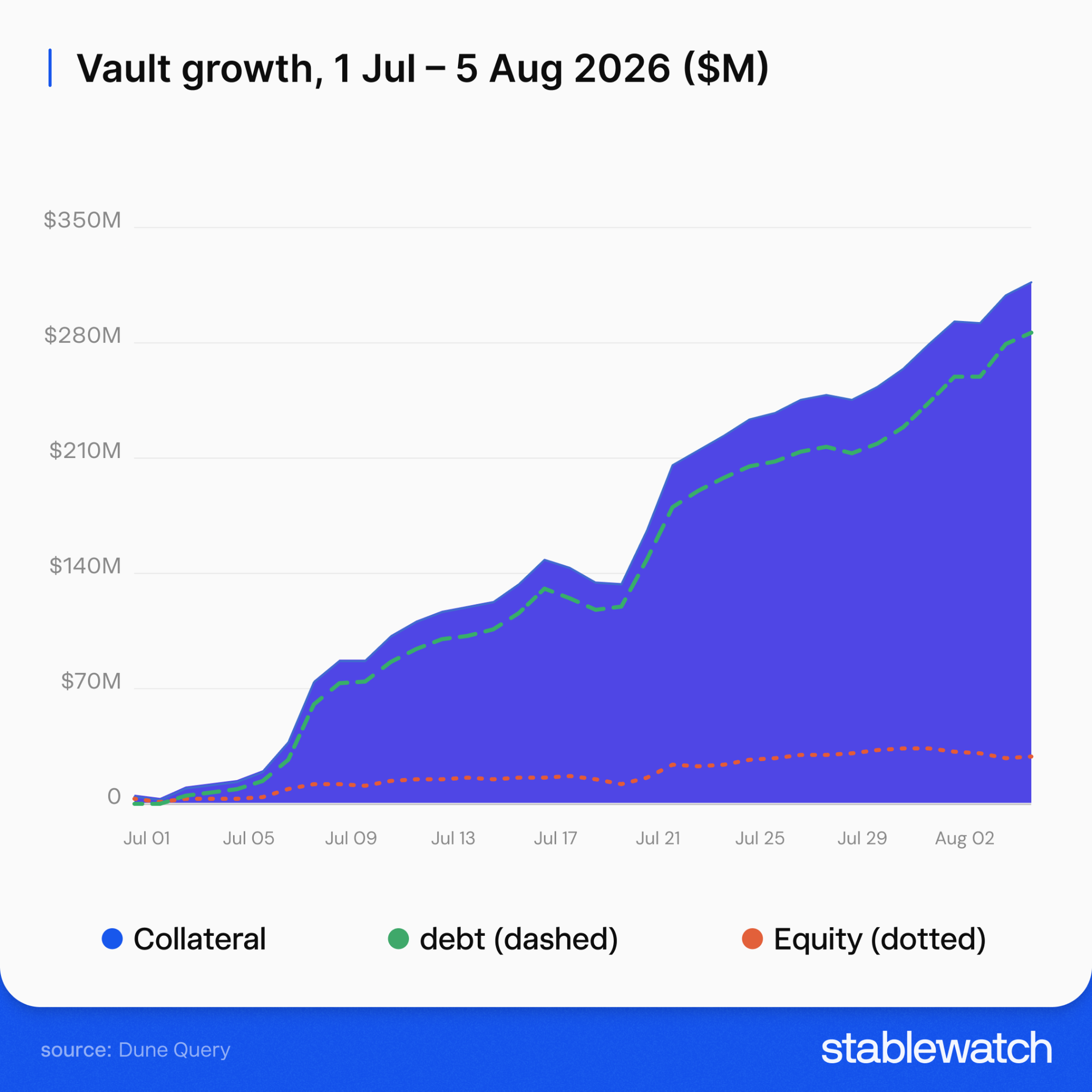
Using on-chain data, we analyze all borrower positions in the Robinhood vault. As of this writing, institutional borrowers with positions (>$1 million) account for the majority of outstanding debt and primarily employ leveraged strategies. Retail participation is present and growing, but these borrowers typically use less leverage and represent only a small share of the vault’s current debt. The vault’s high leverage is enabled by the careful selection of collateral assets and tailored oracle designs. This bootstrapping strategy helped the vault attract $324 million in collateral within its first 30 days.
Data
The analysis covers borrower positions in the three USDG lending markets: USDe/USDG, syrupUSDG/USDG and spUSDG/USDG. We use Dune queries to gather data from the vault's inception on 1 July 2026 until 5 August 2026. All queries and underlying data are published in the accompanying Dune dashboard.
Two datasets are used. A position-level snapshot at 5 August 2026 covering 190 borrower positions held by 175 unique addresses, and a daily panel of the same fields for every day of the vault's life (1 July – 5 August 2026). The three Morpho markets share USDG as the loan asset and use USD-denominated yield-bearing collateral:
- Ethena USDe (a synthetic dollar backed by delta-hedged derivatives),
- Maple syrupUSDG (private credit pool) and
- Spark spUSDG (savings-rate yield).
All three markets share a 91.5% liquidation loan-to-value (LLTV), implying a maximum of 11.8x leverage.
Definitions
Whale: an address with more than $1M of collateral in the vault. There are 36 whales, and they account for 98.3% of the vault's debt.
Super whale: an address whose debt exceeds 10% of a single market's total debt. Such an address is large enough to materially affect that market's utilization, interest rates or solvency. There are six super whales: two in USDe, two in syrupUSDG and three in spUSDG. One qualifies in two markets.
Active borrower: position with more than $100 of debt. Of the 190 loan positions, 95 are active. The remaining positions contain only minimal balances.
Methodology
Leverage is calculated at the position level as collateral value divided by borrower equity:
Leverage = collateral value / (collateral value − debt value)
For example, a position with $10M of collateral and $9M of debt has $1M of equity and 10x leverage. This measure shows how much collateral exposure is supported by each dollar of borrower equity.
Vault-level leverage is reported on a dollar-weighted basis, weighting each position by its collateral value, because the simple average across addresses is dominated by numerous dust positions. Leverage alone does not prove that the borrowed USDG was used to buy more collateral. A borrower could deploy it in another DeFi protocol or strategy. We therefore reviewed the broader on-chain positions of every whale address, not only its loan positions in the Robinhood vault. We use Robinhood on-chain data for this analysis, with each whale's positions across protocols visualised using DeBank. Classification is per address. One entity may control several wallets, so all concentration figures are lower bounds.
2. Vault Overview: One Strategy Across Three Markets
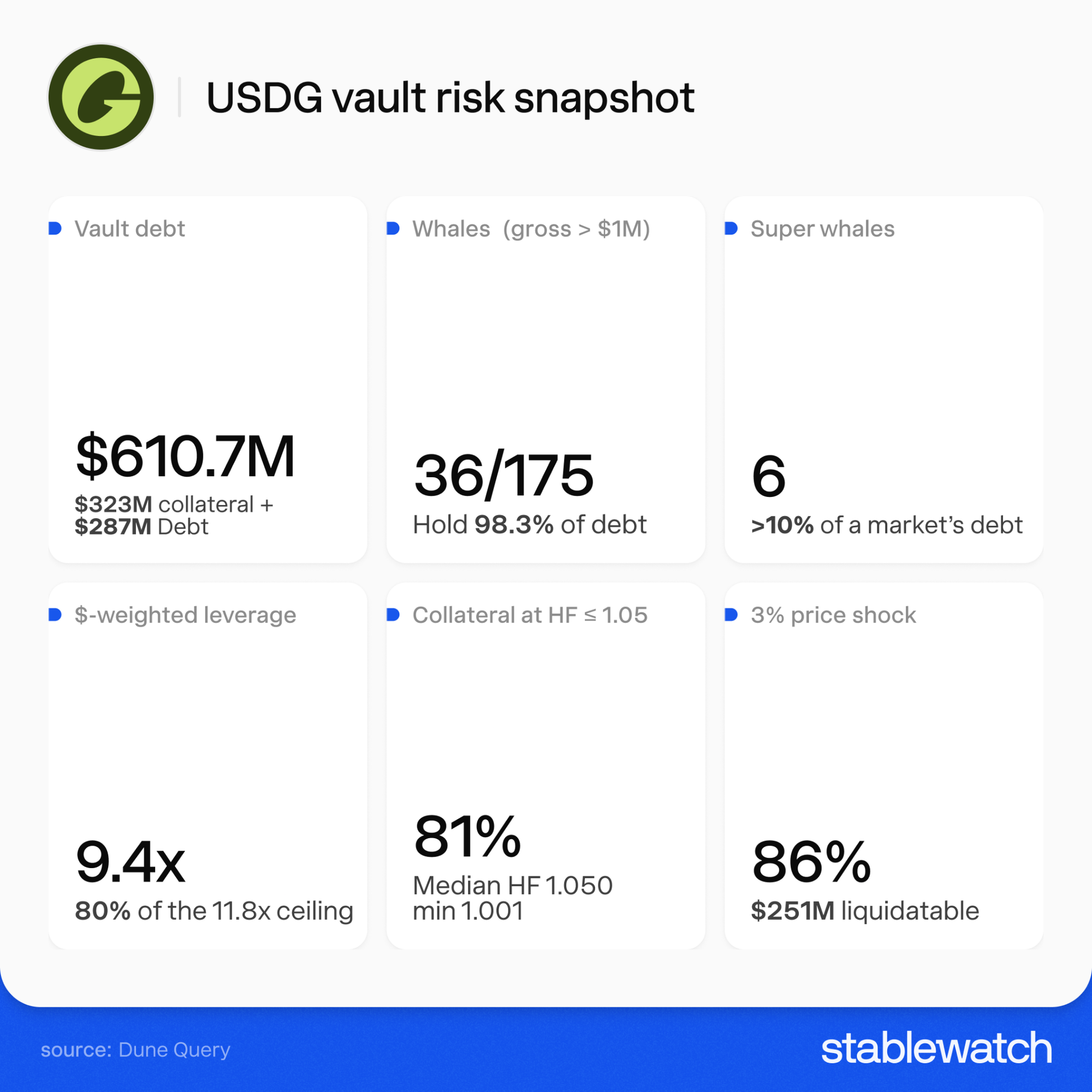
The vault collectively holds $323.8M of USD-denominated collateral assets against $286.8M of USDG debt. The vault allocates across three markets - USDe/USDG, syrupUSDG/USDG, spUSDG/USDG, and borrowing activity is dominated by leveraged looping in each market. A borrower supplies a (yield-bearing) stablecoin as collateral, borrows USDG at approximately 90% LTV, swaps the borrowed USDG for more of the collateral asset and supplies it again. Repeating this process increases leverage until the position approaches the permitted limit.
Consequently, the vault has one core risk exposure across all three markets: collateral asset yields stay above the USDG borrow rate, and the collateral asset maintains its pegs.
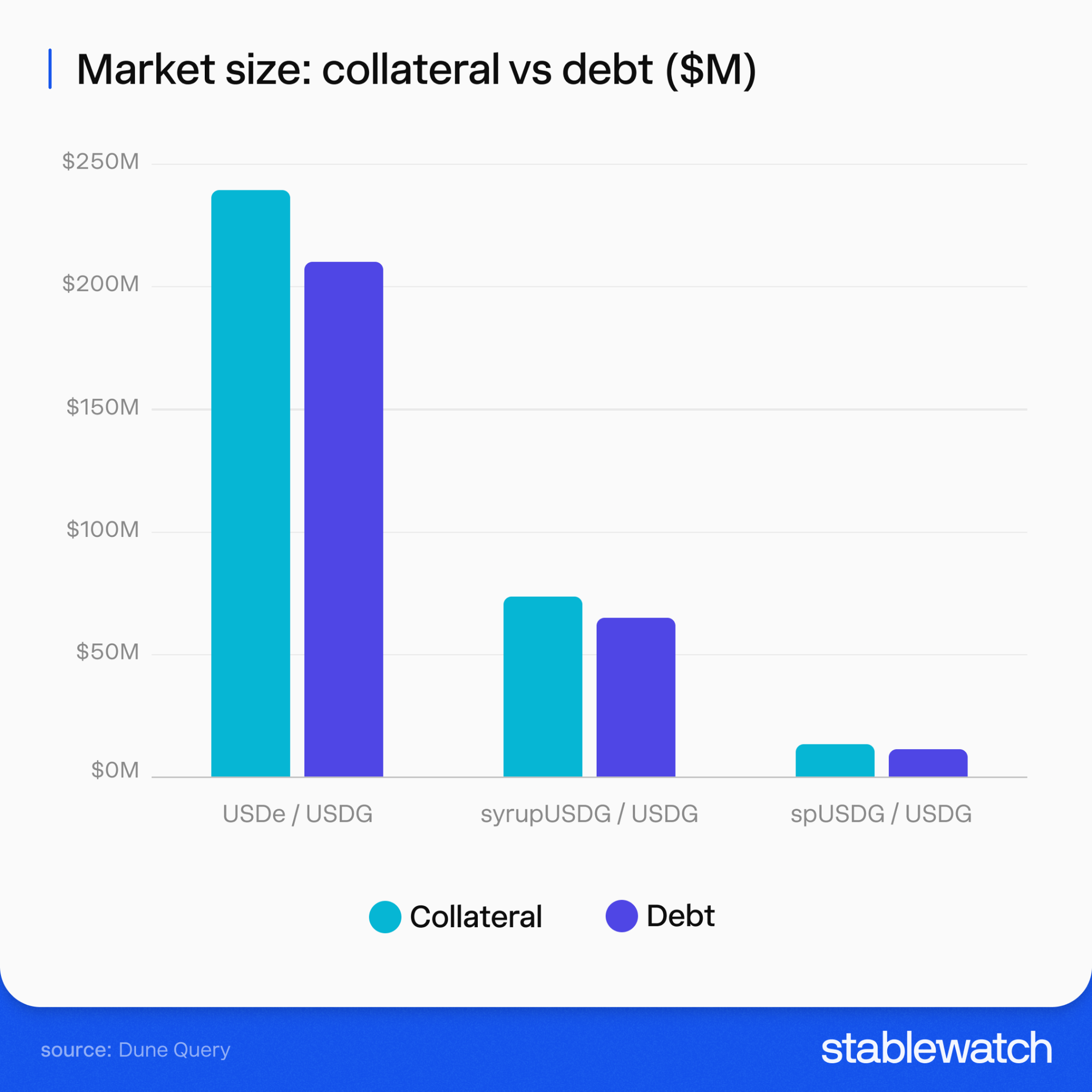
Concentration of the vault borrowers is high, which can be attributed to the bootstrapping phase. Thirty-six whales account for 98.3% of the vault's debt. The largest borrower holds 23.9%, while the ten largest hold 73.3% (Gini coefficient: 0.906). Two entities dominate the vault. Address 0x502d… holds $68.6M of debt across two markets, accounting for 22.1% of USDe debt and 33.4% of syrupUSDG debt. Address 0x7bee… holds $45.2M of debt, or 21.4% of the USDe market. Together, these two entities account for approximately 40% of the vault's debt. Thirteen borrowers are active in more than one market. Their activity creates direct links between the three markets. Concentration has eased as the vault has grown, the top borrower's share fell from 30.5% to 23.9% over the observation period.
For comparison, Morpho markets with syrupUSDC as collateral on Ethereum are also highly concentrated, despite the longer track record. Largely, this is a result of the number of market neutral funds operating levered carry trades on DeFi protocols at that size being limited.
3. Leverage Distribution
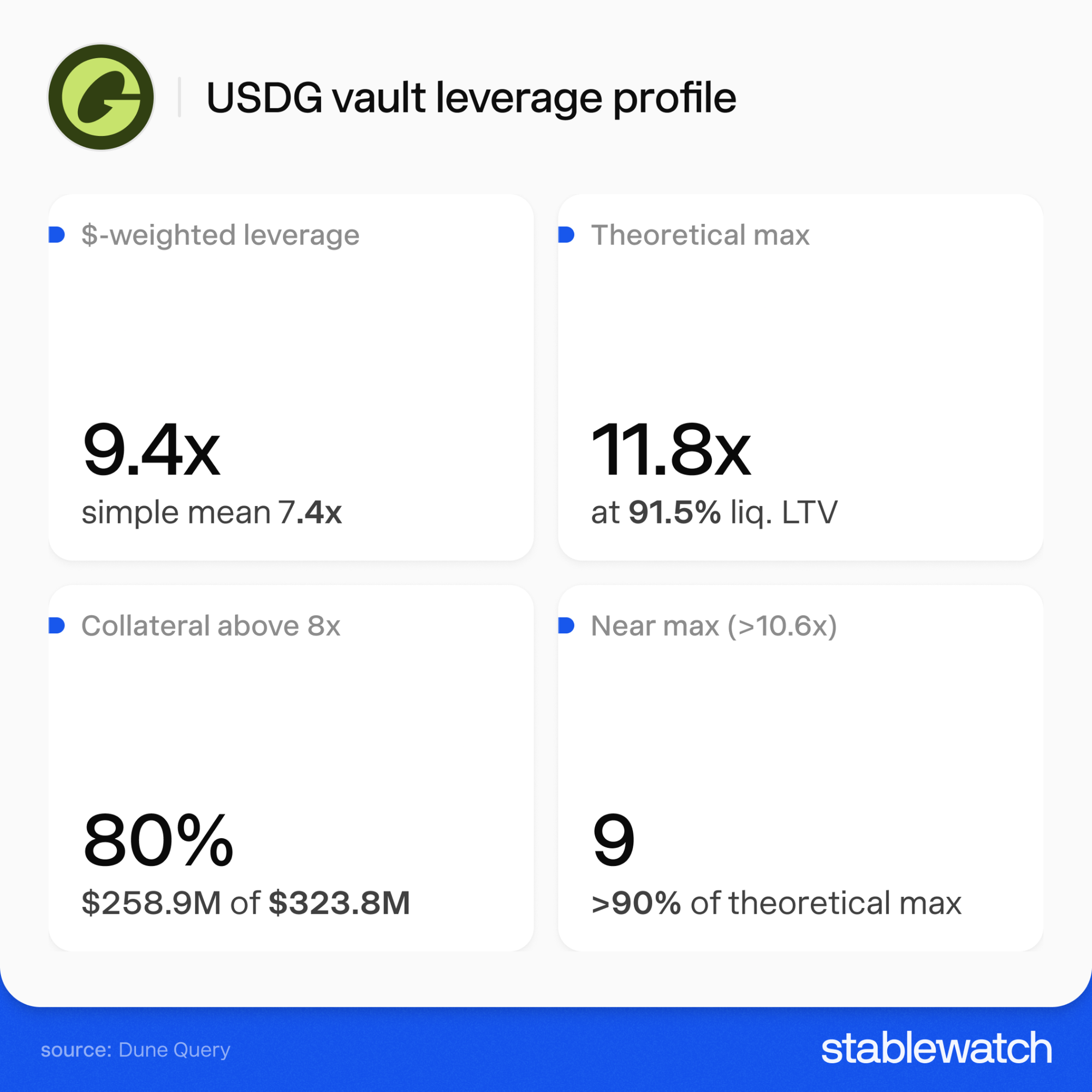
The leverage distribution has two distinct groups with most capital concentrated in the higher-leverage group. Twelve of the 95 active borrowers use leverage of 1–2x, together accounting for only approximately $3.2M of collateral. Leverage in larger positions begins above 5x: the 73 borrowers above this level hold 98% of all collateral ($317.8M). As a result, the simple average leverage of 7.4x is misleading. The dollar-weighted average leverage stands at 9.4x.
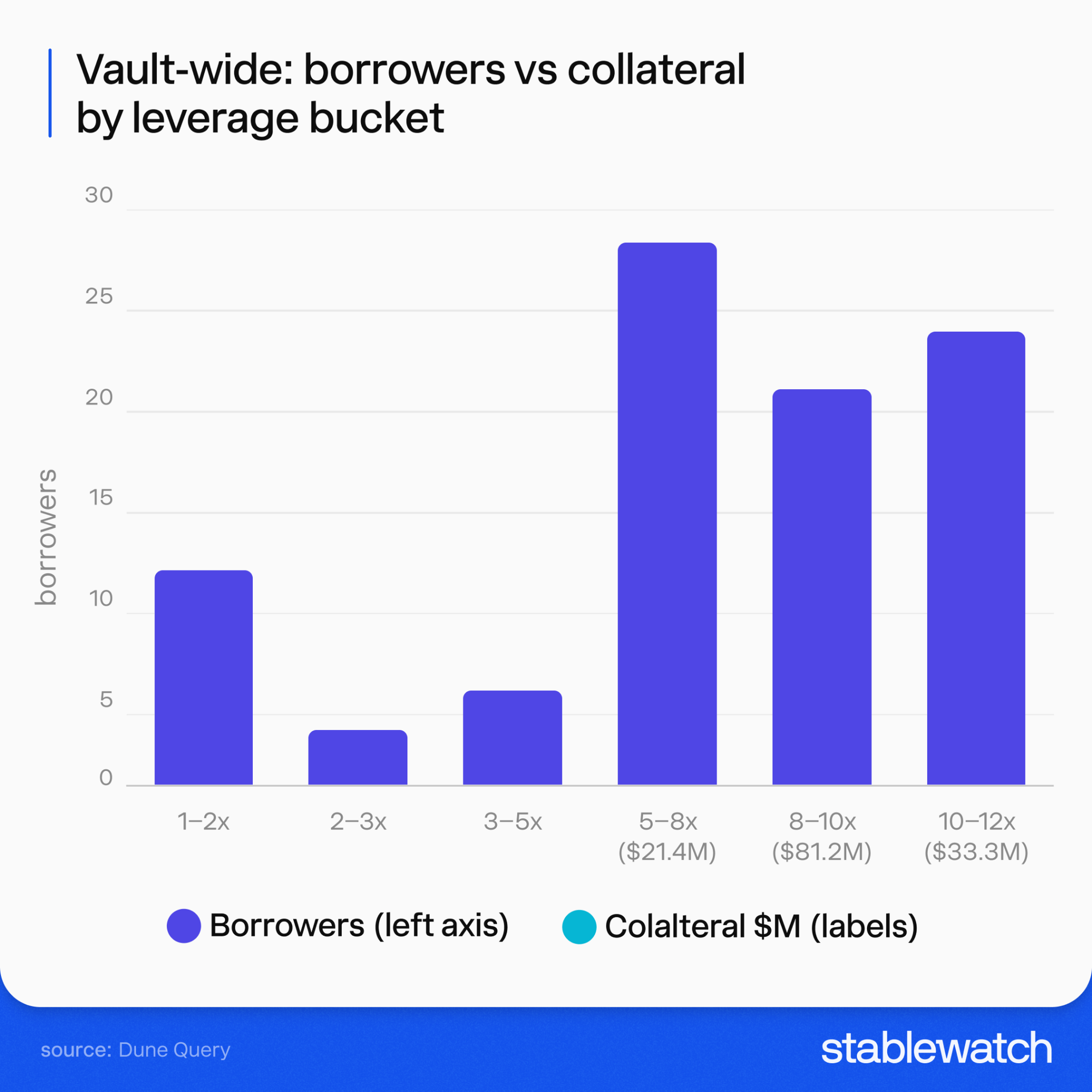
The vault operates at approximately 80% of its theoretical maximum leverage. With a 91.5% liquidation LTV, the maximum possible leverage from repeated looping is 11.8x. The dollar-weighted average of 9.4x equals 80% of this limit. Nine positions exceed 90% of the limit, with leverage above 10.6x. Higher leverage directly reduces the safety margin. Positions in the 8–10x range have a median health factor (HF) of 1.021; positions in the 10–12x range have a median HF of 1.011. At these levels, each additional loop further reduces the buffer before liquidation.
Larger positions use more leverage. The correlation between the logarithm of collateral value and leverage is +0.67. Median leverage is 9.9x for positions above $1M, compared with 4.9x for positions below $100k. This is the opposite of the common belief that retail users operate at higher leverage than institutional allocators. In the Robinhood vault, the largest borrowers use the most leverage. This pattern is consistent with sophisticated participants equipped with proper monitoring tools who conducted deep due diligence on the tokens, markets and oracle set-ups.
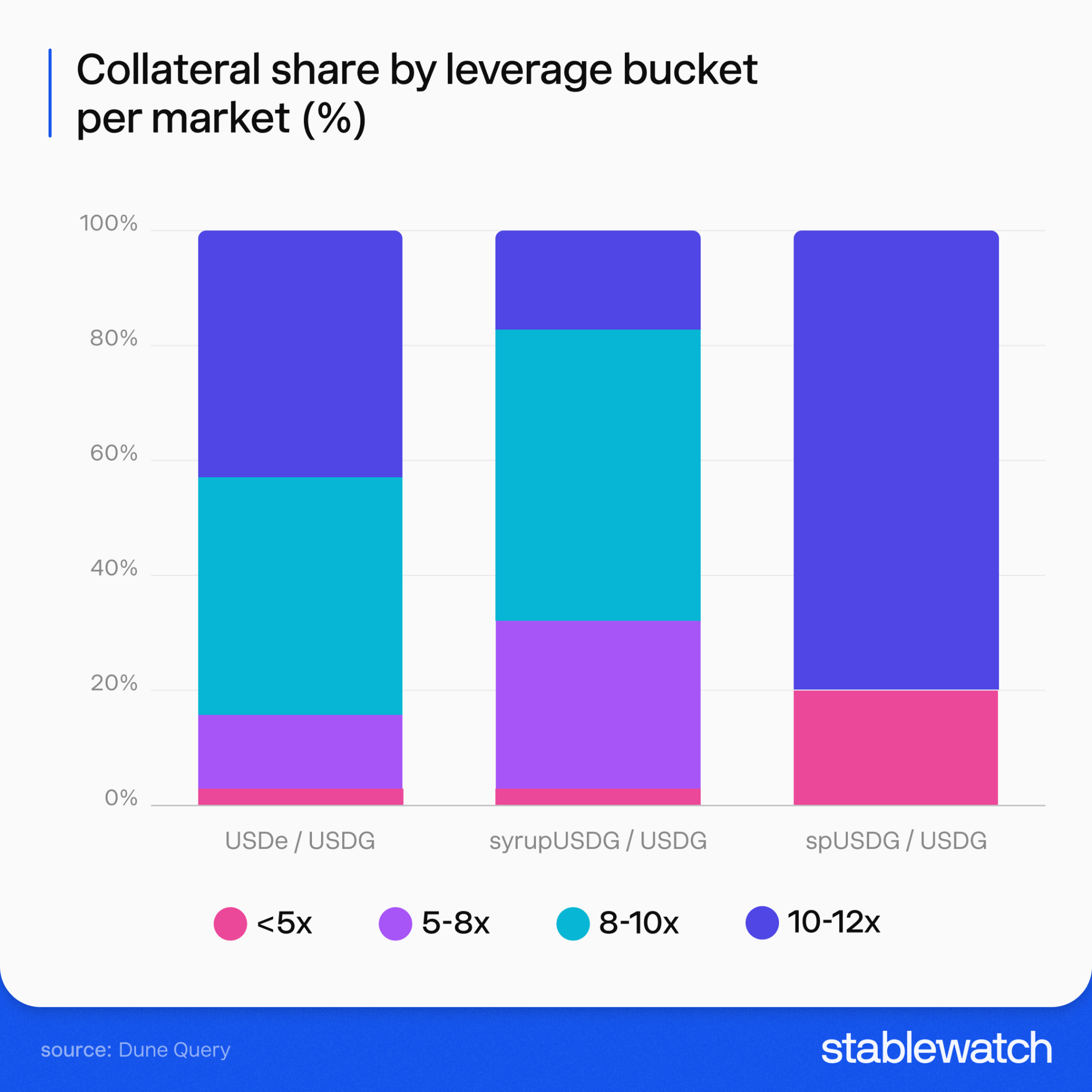
Median leverage increases as market size decreases: 7.7x in USDe, 9.8x in syrupUSDG and 10.2x in spUSDG. However, the composition of each market differs. USDe has the most consistently leveraged borrower base, with 84% of its collateral above 8x. spUSDG has two distinct groups: one conservative whale at 1.4x holds 20% of its collateral, while positions at 10–12x hold 79%. syrupUSDG falls between these two structures, with 48% of collateral at 8–10x. On a dollar-weighted basis, USDe has the highest leverage at 9.5x. It therefore represents the largest source of absolute risk.
4. The Three Markets
USDe / USDG - The Flagship Market
USDe accounts for 74% of the vault's debt. Three large borrowers, each with $21–52M of collateral and leverage of 9.5–11.1x, hold 52% of the market's debt. Their health factors range from 1.00 to 1.02. The other 57 active borrowers account for a limited share of the market.
The main exposure in this market is Ethena risk. USDe is a 3rd largest USD-stablecoin in market capitalization. Its yield and peg stability was initially assured by strategies involving perpetual futures on ETH/USD but moved to the more diversified liquid book today. It carries the highest dollar-weighted leverage. One position has leverage of 11.1x and an HF of 1.005. An adverse price move of approximately 0.5% would make it liquidatable, yet as both USDe and USDG are stablecoins pegged to USD this scenario remains unlikely.
syrupUSDG / USDG - One Whale’s Market
Address 0x502d… holds 33.4% of the market's debt, with leverage of 9.8x and an HF of 1.019. The second-largest borrower holds 18.8%, and the remaining debt is distributed among several smaller borrowers.
This market is the most resilient to very small shocks — no collateral becomes liquidatable at a 0.5% move — but its liquidation sensitivity increases sharply between 1% and 2%, where the share of liquidatable collateral rises from 5% to 63%.
spUSDG / USDG - Small and Barbelled
This is the smallest market, with only eight active borrowers. Its largest position uses 11.7x leverage and has an HF of 1.001 — the most fragile position in the vault. This position alone causes 41% of the market's collateral to become liquidatable after a 0.5% adverse price move, and with the second-largest position 49%.
The market also contains the vault's only clearly conservative whale, with leverage of 1.4x and an HF of 3.25. Collateral utilization is the lowest of the three markets, at 78%.
Oracle Impact
The USDe/USDG market uses a MetaOracleDeviationTimelock. The oracle initially values USDe at a hardcoded 1:1 rate and uses a secondary-market price as a backup. It switches only if the market price deviates by more than 0.5% for over 16 hours. An adverse price move of approximately 0.5% is exactly the threshold that would trigger the liquidation of the highest leveraged loan position in the vault.
The spUSDG/USDG and syrupUSDG/USDG markets do not rely on the exchange-rates oracles. Instead, the loan position is value based on the tokens’ NAV rather than their secondary-market prices. They are therefore not exposed to temporary liquidity-driven de-pegs on exchanges. NAV is the price used by the issuers to mint or burn (redeem) tokens. This oracle set-up is the state-of-the-market for this type of tokens and is becoming widely adopted by RWAs within Morpho.
Comparison
While USDe is a USD-denominated stablecoin, syrupUSDG and spUSDG are yield-bearing tokens. Their price gradually increases over time and the oracles point to NAV price. Consequently, these markets have higher leverage at the position level, as leverage decreases over time due to the appreciation in value of the collateral asset. Median leverage increases from 7.7x in USDe to 9.8x in syrupUSDG and 10.2x in spUSDG. The minimum HF declines from 1.005 to 1.007 and then 1.001. The YBS markets are therefore more sensitive to small price moves in relative terms, while USDe remains the main source of absolute risk.
The three markets are not independent. Thirteen borrowers, led by 0x502d…, are active in more than one market. Simultaneous withdrawals, or liquidations in one market, could force them to reduce positions in the others. Sudden withdrawals could therefore create simultaneous USDG liquidity pressure across all three markets.
5. Liquidation stress test
Positions are concentrated near the liquidation threshold. In total, 81% of the vault's collateral, or $262.0M, has an HF at or below 1.05. Liquidation sensitivity begins with very small price changes. A 0.5% adverse collateral price move would make $27.9M liquidatable, equal to 9% of the vault's collateral. A 2% move would make $190.7M liquidatable, or 59%. A 3% move would make $256.5M liquidatable, or 79%.
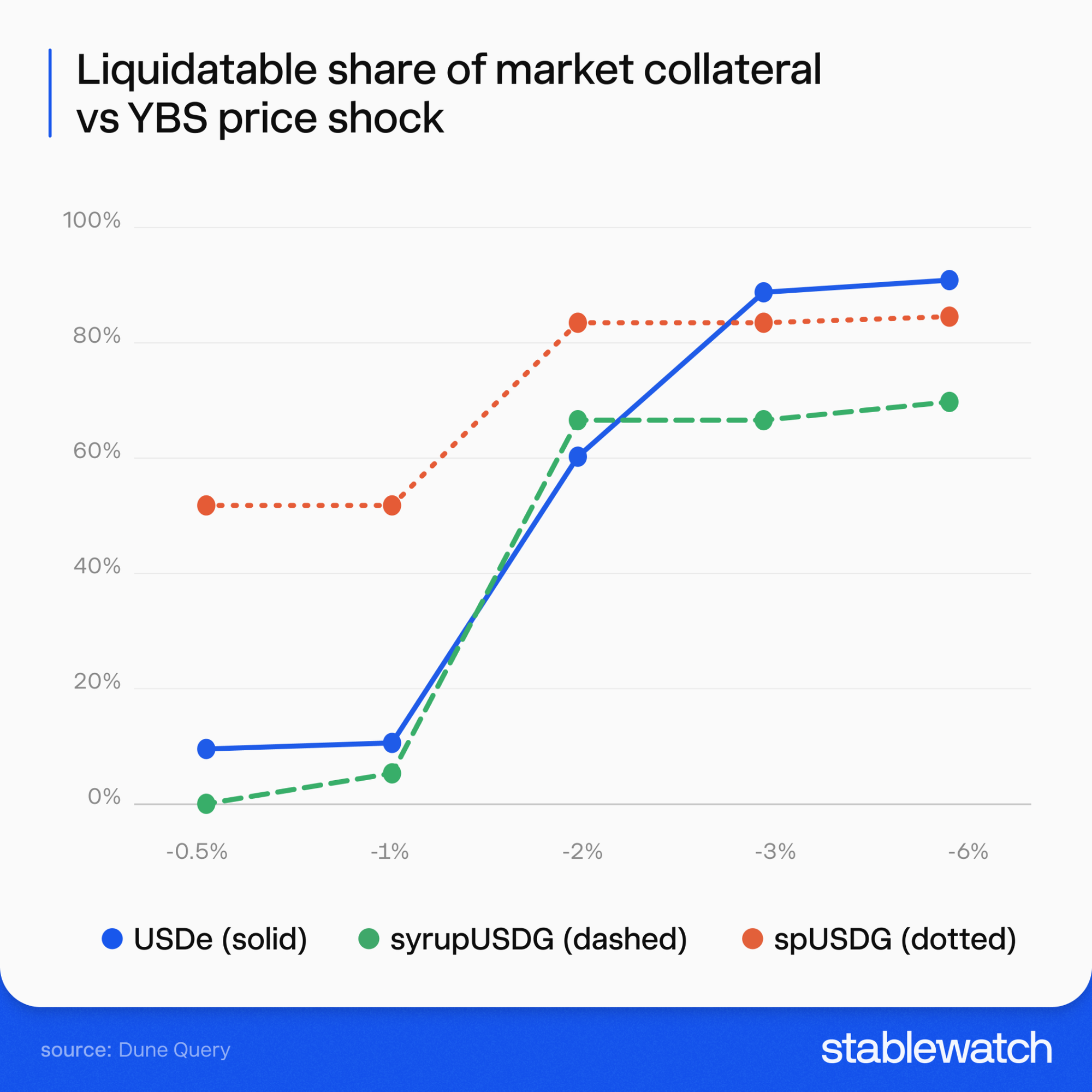
In comparison, no collateral in the syrupUSDC markets became liquidatable after a price move of less than 9%.
In DeFi lending, borrowers absorb the risk of the high leverage they set. Yet lenders are exposed to liquidation risk. If an under-collateralized loan position is liquidated too late, the vault might accrue bad debt, which very rarely happens on Ethereum markets. In the case of the Robinhood vault, the selected assets - USDe, syrupUSDG, spUSDG - are among the most liquid USD-denominated assets in DeFi, with deep arbitrageur networks. It can be expected that even larger price shocks will be absorbed by the market.
6. Conclusions
The Robinhood vault solved one of the hardest problems in DeFi: bootstrapping a new blockchain ecosystem and new lending markets. In particular, a lending market requires simultaneously attracting borrowers who create demand and pay interest, and lenders who supply capital and earn yield.
Whereas, lenders are attracted with the incentive program and 7% yield, initiating the borrowing side is complex. Steakhouse’s solution was to engage the institutional allocators - participants who can perform deep due diligence on the collateral assets, understand the carry strategy, actively manage their positions, and are comfortable executing at high leverage.
The strategies employed here require genuine technical understanding: not just token market dynamics, but the distance of each position from the liquidation threshold, the oracle mechanism that determines when liquidation is triggered, and the liquidity depth available to execute a liquidation without significant slippage. Retail participants in the vault operate at lower LTV ratios, which is consistent with having less certainty about these factors.
The Robinhood vault’s concentration today is a snapshot of a market that has successfully completed its first and hardest step. What the data does not show is the backdoor exercise required: identifying the right participants, designing the collateral framework, and building the relationships that bring institutional capital to a new chain.
Future Outlook
Looking ahead, the current borrower profile should be viewed as a function of a newly launched ecosystem rather than a steady-state outcome. As the Robinhood Chain ecosystem matures and in-app borrowing expands across a broader range of assets, the loan book is expected to become more diversified-both in terms of collateral composition and borrower concentration.
This evolution should also support higher organic yields. A useful benchmark is Coinbase, where in-app borrowing has grown into a multi-billion-dollar loan book. Robinhood follows a similar trajectory, it could create the next liquidity flywheel-this time time in reverse. Robinhood already has a massive retail deposit base and can grow borrowing demand on top of it, potentially accelerating the flywheel from day one.
7. Takeaways
For the new vault operators and curator
- The Robinhood vault illustrates that launching a new lending market requires deliberate management of both lending and borrowing side. The lender side can be seeded through incentive programmes and distribution - Robinhood's user base provided deposit-side liquidity quickly.
- The borrower side requires more careful construction. Sustainable borrowing demand that generates organic yield requires institutional allocators willing to deploy at scale and operate consistently. Steakhouse secured that demand first with retail adoption followed. Given the current concentration in 16 allocators, active monitoring and ongoing engagement with these borrowers is paramount.
For lenders (Robinhood users)
- Understand the source of yield. A portion of the current 7% APY is incentive-subsidised. The organic component depends on borrower demand and the carry available in the collateral tokens.
- Key due diligence questions: How long do incentive programmes run, and what is the available collateral set and activated borrow demand at the time of incentives easing? What is the liquidity of the collateral tokens under stress? USDe, syrupUSDG, and spUSDG have deep secondary markets and present manageable liquidation risk under most scenarios.
For borrowers
- The oracle design is the most key technical factor in a looping strategy. The Robinhood vault uses NAV-referenced oracles for syrupUSDG and spUSDG - the appropriate design for yield-bearing stablecoins whose value accretes according to fund administrator pricing rather than continuous trading. This meaningfully reduces liquidation risk for borrowers running looping strategies.
Disclosure: the author is strategic advisor to Nook, a neobank. Neither the author nor Nook holds a position in the Robinhood USDG vault or the assets discussed.