What Backs Your Savings? Inside Osero’s Backing Transparency
A savings rate is easy to compare.
Understanding what actually sits behind it is harder.
Two products can show a similar APY while relying on completely different assets to generate it. One might depend heavily on crypto lending. Another might hold government debt, stablecoins, or institutional credit. Most use some combination of different sources.
That composition matters because every asset comes with its own return profile, liquidity characteristics, counterparties, and risks.
The Backing panel in the Osero App helps make this part of the system clear. Rather than just showing the yield, it gives users an up-to-date look at the main asset categories backing sUSDS, refreshing approximately every five minutes.
This article explains what these categories mean, why the mix is important, and how to read the Backing panel without needing to know every single position.
Key Highlights
- The Backing panel in the Osero App displays the main asset categories backing sUSDS, so users can see what supports their savings.
- The backing includes different asset types, such as stablecoins, onchain lending, short-term Treasury bills, OTC crypto lending, corporate debt, and other approved positions.
- Each asset plays its own role and comes with its own risks. That’s why the mix matters just as much as the yield.
- The backing changes over time. Positions can be added, removed, mature, or rebalanced, and Osero always shows the current mix.
- Backing is just one part of the story. Osero also shows Liquidity and Capital Protection, so users can see what assets support withdrawals and what capital is there to absorb potential losses.
Start With the Question Behind the APY
The Sky Savings Rate earned by sUSDS is supported by a broader balance sheet containing different assets and financial positions. Rather than relying on a single lending market or investment strategy, that backing can span both onchain markets and more traditional financial instruments.
You can view this in detail here.
This leads to a simple question: What is actually backing my savings?
A high-level answer is presented in the Backing Panel in the Osero App:
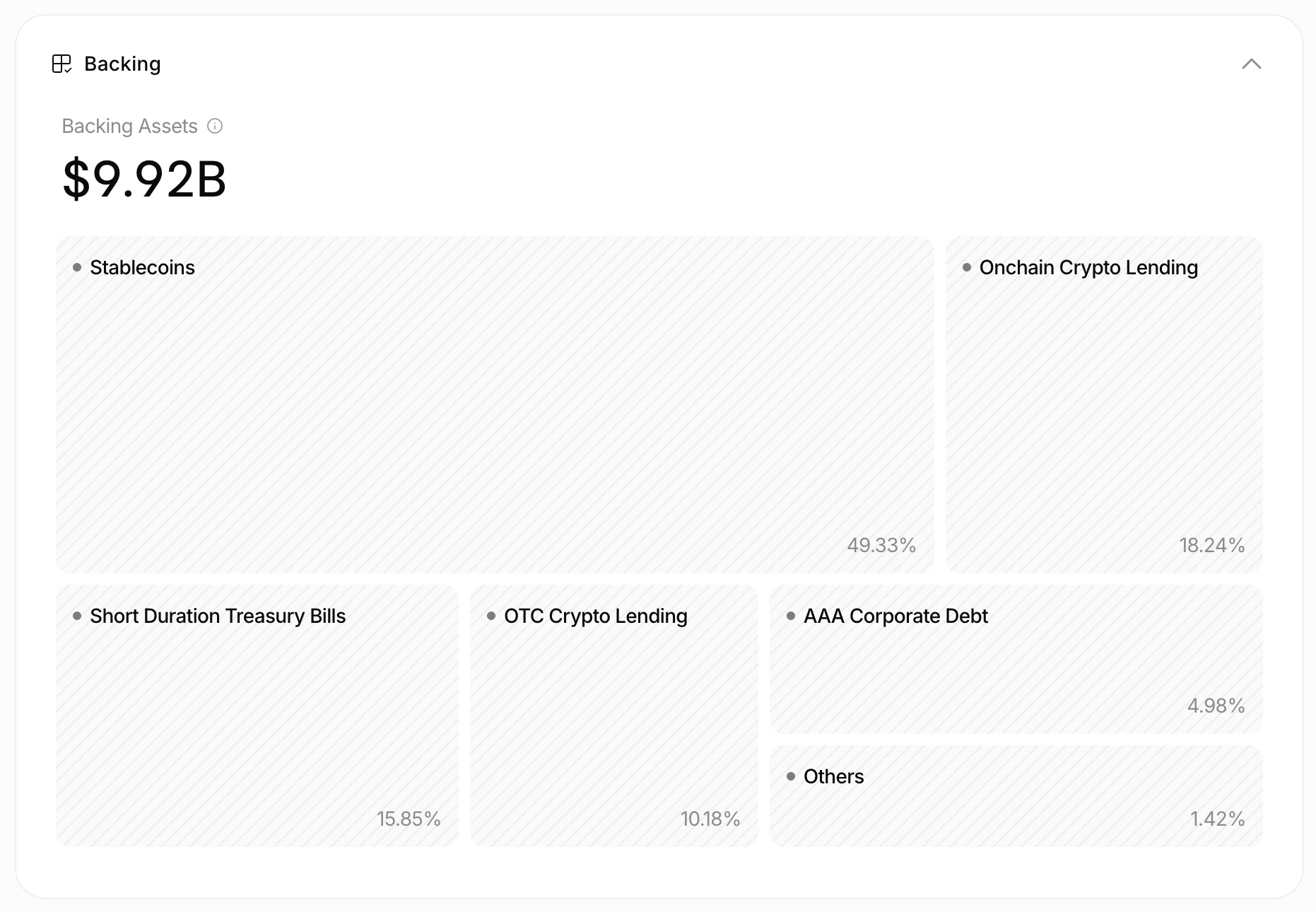
The Backing Panel in the Osero App shows the current mix of main asset categories behind USDS and sUSDS, as of September 2026.
The backing is grouped into broad categories, so users don’t have to look at every single position. If the user wants to learn more about a given category, they can click on it to show more details.
This gives you a balance-sheet overview, helping you see which types of assets support the system and how the mix changes over time.
What Actually Sits Behind USDS and sUSDS?
The categories represent different parts of the portfolio. Osero keeps this view intentionally high-level, but the underlying positions can be explored in more detail through the Sky Financial Dashboard.
Stablecoins
Stablecoins are the largest and often the most familiar part of the backing. This category can include assets such as USDC, USDT, and PYUSD, held across structures including the Peg Stability Module (PSM), lending protocols, liquidity positions, and allocations made through Sky Agents.
For example, the PSM holds stablecoins that can be converted directly with the protocol, helping provide liquidity for USDS. The exact stablecoins, positions, and amounts can change over time.
Onchain Crypto Lending
This category includes lending positions executed through blockchain-based protocols.
In simple terms, capital is supplied to an onchain lending market, where borrowers pay interest to access it. These positions are generally overcollateralized, with collateral and liquidation rules enforced through smart contracts.
Examples can include allocations across established onchain lending infrastructure such as Spark and Morpho markets, depending on the current portfolio. Because these positions are onchain, their collateral, utilization, and activity can often be independently monitored.
This makes onchain lending different from the privately negotiated credit arrangements included in the OTC category below.
Short-Duration Treasury Bills
Part of the backing comes from traditional financial markets.
Short-duration Treasury bills are U.S. government debt instruments with relatively short maturities. Sky gains exposure to them through its capital allocators rather than the protocol directly opening a traditional brokerage account and buying Treasury bills itself.
Some of that exposure is brought onchain through tokenized funds. One example visible in Sky's current allocations is BUIDL, BlackRock's tokenized U.S. dollar institutional liquidity fund, with the tokenization infrastructure provided by Securitize.
This creates a bridge between traditional fixed-income markets and onchain finance: the underlying exposure comes from traditional financial instruments, while tokenization allows positions to be represented and used within blockchain-based financial infrastructure.
OTC Crypto Lending
Not all crypto lending happens through public DeFi protocols.
OTC, or over-the-counter, crypto lending covers privately structured lending arrangements with institutional counterparties. Terms can be negotiated directly rather than determined by a public lending market.
Sky's broader institutional network has included counterparties such as Anchorage and Galaxy, alongside other institutional capital providers.
The distinction matters because an onchain loan and an institutional OTC loan may both generate income, but they operate differently. Counterparty relationships, custody, collateral management, settlement, and liquidity can all differ from a lending position executed entirely through smart contracts.
AAA Corporate Debt
This category represents exposure to highly rated corporate debt.
Unlike Treasury bills, where the borrower is the U.S. government, corporate debt is issued by companies. AAA is the highest tier of the major credit-rating scales and generally indicates very strong assessed creditworthiness, although it does not make an investment risk-free.
These positions add another source of yield and credit exposure to the backing, reducing reliance on crypto lending or government debt alone.
Other Positions
Not every approved asset fits into the main categories.
Other Positions covers remaining backing exposures that do not fall into the primary groups above. Depending on the portfolio, this can include smaller onchain credit positions, basis-trade structures, and other approved collateral types.
Keeping these positions grouped together makes the Backing panel easier to read while the more detailed underlying allocations remain available through Sky's transparency tools.
Why the Mix Matters
The point of showing these categories is to show that the system does not depend on one single source.
Imagine a savings product backed only by one lending market. Its performance would depend heavily on that market’s borrower demand, liquidity, collateral, and the protocol.
A portfolio that includes stablecoins, lending, government debt, corporate credit, and other assets is structured differently.
Different assets can generate income in different ways and respond differently to changing market conditions.
This doesn’t remove risk. Diversification can’t guarantee there won’t be losses, and each asset still carries its own risks related to issuers, counterparties, markets, settlement, liquidity, and infrastructure.
Diversification changes where the system’s risks come from.
That’s exactly why it’s helpful to see the asset mix.
A headline APY shows the current return, but the Backing panel provides more context on the assets behind it.
A Snapshot, Not a Static Portfolio
The percentages are meant to change.
Positions can mature, new ones can be added, existing exposures can be reduced, and capital can shift as allocations are rebalanced.
A portfolio with a certain percentage in Treasury bills, stablecoins, or lending today might look different next month.
That’s why Osero shows Backing as a snapshot of the current system, not as a fixed allocation policy.
When you look at the panel, it’s helpful to ask not just “what percentage is in each category?” but also: What does the current mix say about the assets supporting the system right now?
Backing Is Only One Part of the Risk Picture
Knowing what assets exist is important, but it does not answer every question about a savings product.
- Backing shows the broad asset composition of USDS and sUSDS.
- Liquidity shows the portion associated with active liquidity support, including Actively Stabilizing Collateral.
- Capital Protection shows the capital buffers meant to absorb losses before they affect USDS holders.
Each of these answers a different question:
What backs the system? What can support withdrawals? What is designed to absorb losses?
Keeping those questions separate makes it easier to evaluate the system without reducing risk to a single number.
Read more in the Osero docs.
Why This Matters
Stablecoin savings are often compared by APY.
It is understandable. Yield is visible, easy to rank, and directly connected to what a user expects to earn.
But APY alone cannot tell you how that yield is supported.
If two savings products both offer 5%, the number itself says nothing about whether the underlying exposure comes from a single lending market, leveraged crypto positions, government securities, corporate credit, or a diversified balance sheet combining several of them.
That information changes how the product should be understood.
Osero's approach is to expose more of the financial structure underneath the rate.
Combined with Osero's Liquidity and Capital Protection views, it provides a more complete way to evaluate stablecoin savings: not only by what they yield, but by what sits behind that yield.
Frequently Asked Questions
What types of assets are part of the backing?
The main categories currently include Stablecoins, Onchain Crypto Lending, Short-Duration Treasury Bills, OTC Crypto Lending, AAA Corporate Debt, and Other Positions.
Why does the backing include different asset types?
Different parts of the underlying portfolio can be allocated across asset classes and financial positions. Showing these categories makes it possible to understand the overall composition rather than looking only at the system's yield.
Does the Backing panel always show the same allocation?
No. The composition can change as positions are added, removed, mature, or are rebalanced. The panel should therefore be read as a current view of the backing rather than a fixed allocation.
Does diversified backing mean there is no risk?
No. Diversification does not eliminate risk. Risks related to underlying assets, issuers, counterparties, markets, settlement, infrastructure, and liquidity can still apply.
Is everything shown in the Backing panel in the Osero App immediately available for withdrawals?
Not necessarily. Backing and liquidity are different concepts. The Backing panel shows the broader asset composition, while Osero's Liquidity view separately provides information about the portion associated with active liquidity support.