How Whales Loop Yield-Bearing Stablecoins, Step by Step

By Krzysztof Gogol, Dawid Rymarczyk, and Igli Kristo
Contrary to common belief, it is the largest borrowers in DeFi who are behind the most leveraged stablecoin positions. Yet, the liquidations almost never happen.
Across Aave and Morpho, the largest holders of yield-bearing stablecoins (YBS) routinely operate at 5-8x leverage and, in certain cases, even more than 8x. Some operate with health factors barely above the liquidation threshold. Yet across more than two years of onchain data, none of the positions we studied were liquidated.
This study reveals that whale borrowers are not exposing themselves to excessive risk, but carefully adjust LTV (loan-to-value) to each YBS token. What is even more interesting is that, once leverage and LTV are in place, they are rarely adjusted. Only 7.2% of observed looper-days involved a leverage adjustment, even as hundreds of millions of dollars were allocated to positions with low health factors.
That tells us something important about how professional capital is using yield-bearing stablecoins in DeFi lending. The strategy depends less on actively managed positions than on fundamental due diligence: confidence that the collateral price remains stable, the oracle will behave as expected, and there is a viable exit path if that assumption breaks.
And because most of the liquidation risk concentrates with a surprisingly small number of whale borrowers, what happens to these positions matters far more than what happens to the average borrower.
Key Highlights
• Whales use much more leverage than the average borrower. On Aave, 83.7% of sUSDe borrowers hold positions with 1.1x leverage or less. But just 26 borrowers in the 5-8x band control $275.2 million, while another 48 positions leveraging above 8x hold $118.9 million.
• Once leverage is set, whales rarely change it. Across 2,506 observed looper-days, leverage changed on only 7.2% of days. Reallocations of capital to other YBS positions were a better predictor of adjustments than the absolute leverage level.
• Liquidation risk is highly concentrated. On Aave, whales represent 13.1% of positions in the critical or high-risk band with health factor below 1.05 but account for 97.0% of the collateral value in this band. On Morpho, 22.0% of positions with HF < 1.05 account for 93.1% of the collateral value.
• Thin liquidation buffers have not translated into actual liquidations. 28.9% of looper-days had a health factor of 1.05 or below, and the lowest observed health factor reached 0.998. Still, none of the positions in the sample were liquidated.
• Exit mechanics matter as much as leverage. 18.5% of Aave sUSDe whales have used flash loans, which can unwind an entire loop in a single transaction. None of the Morpho whales in the sample had done so, despite the availability of flash loans.
Introduction
Yield-bearing stablecoins (YBS) were built to solve a simple problem: stablecoins held in a wallet earn nothing. But once those same assets were accepted as collateral in DeFi lending markets, they created an entirely new opportunity. The yield itself could be leveraged.
YBS is typically a USD-pegged token that gives holders exposure to returns generated by its underlying reserves or strategy. Instead of paying those returns separately, the token typically increases in value over time. That means it can continue earning while held in a wallet, being allocated elsewhere in DeFi, or being used as collateral for a loan.
For a large borrower, the obvious next step is looping.
Looping follows a simple process: deposit YBS as collateral, borrow a stablecoin against it, use the borrowed stablecoin to buy more YBS, and deposit again. Each round increases exposure beyond the investor’s own capital and also raises the risk of liquidation.
That is particularly important because the YBS market has become large enough for these positions to matter. According to Stablewatch, the sector’s on-chain supply reached $8.98 billion by May 2025, after peaking at $10.8 billion in February 2025.
This report looks at three major YBS on Ethereum:
- sUSDe (Ethena) - launched in early 2024; $1.4B market cap, 4-8% APY from funding rate arbitrage and active reserve management.
- sUSDS (Sky) - launched in September 2024; $4.7B market cap, 4-6% APY from reserve management.
- syrupUSDC (Maple Finance) - launched in May 2024; $1.0B market cap, 5-8% APY from institutional lending.
Table 1. Yield on leveraged YBS assuming a carry spread of +1.86pp (sUSDe against USDe, on Aave), of +1.86pp (syrupUSDC against USDC on Morpho), of +1.86pp (sUSDS against USDC, on Morpho)
Rather than asking how looping works in theory, we wanted to see what the largest borrowers actually do. How far do they set leverage? How often do they rebalance? What makes them change a position? And what happens when a large share of the market is sitting close to the same liquidation threshold?
The answers suggest that institutional looping is less dynamic than typically believed. Whales take substantial leverage, but they do not constantly optimize it. They appear willing to set leverage near the allowed limits for extended periods, relying on the stability of the collateral and intervening selectively when market conditions change.
That pattern builds on our earlier research into the lending vault on the Robinhood chain. According to that study, institutional investors accounted for 98% of the debt in the vault’s first month and used leverage close to the allowed limits. Across Aave and Morpho on Ethereum, we see a similar pattern: large holders tend to use much of the leverage available to them.
Data and Methodology
We reconstruct the daily balances of all loan positions using sUSDe, sUSDS, and syrupUSDC as collateral across Aave v3 and Morpho Blue on the Ethereum mainnet. We replayed every supply, withdrawal, borrowing, and repayment event using Dune Analytics for the period between March 29, 2024, and June 27, 2026. Loan position is considered at risk when its health factor (HF) falls below 1.05.
We take a holder snapshot on July 14, 2026. A whale is an address whose total YBS exposure exceeds $1 million.
Definitions
YBS Leverage in Aave and Morpho
First, we observe that holders of YBS tokens allocate capital in one of two ways:
- Hold in a wallet, or allocate to other DeFi protocols (e.g., Pendle).
- Fully deploy to a lending protocol.
Blended positions, in which users partially hold YBS in a wallet and partially loop, are relatively rare for any given token. Users who decide to loop loop all of their YBS balances. And as position size increases, lending becomes much more dominant.
For sUSDe, the share of holders using Aave rises from 14.8% to 44% of the total sUSDe value when holders are weighted by exposure, meaning a small number of large holders account for a disproportionate share of the token deployed to lending.
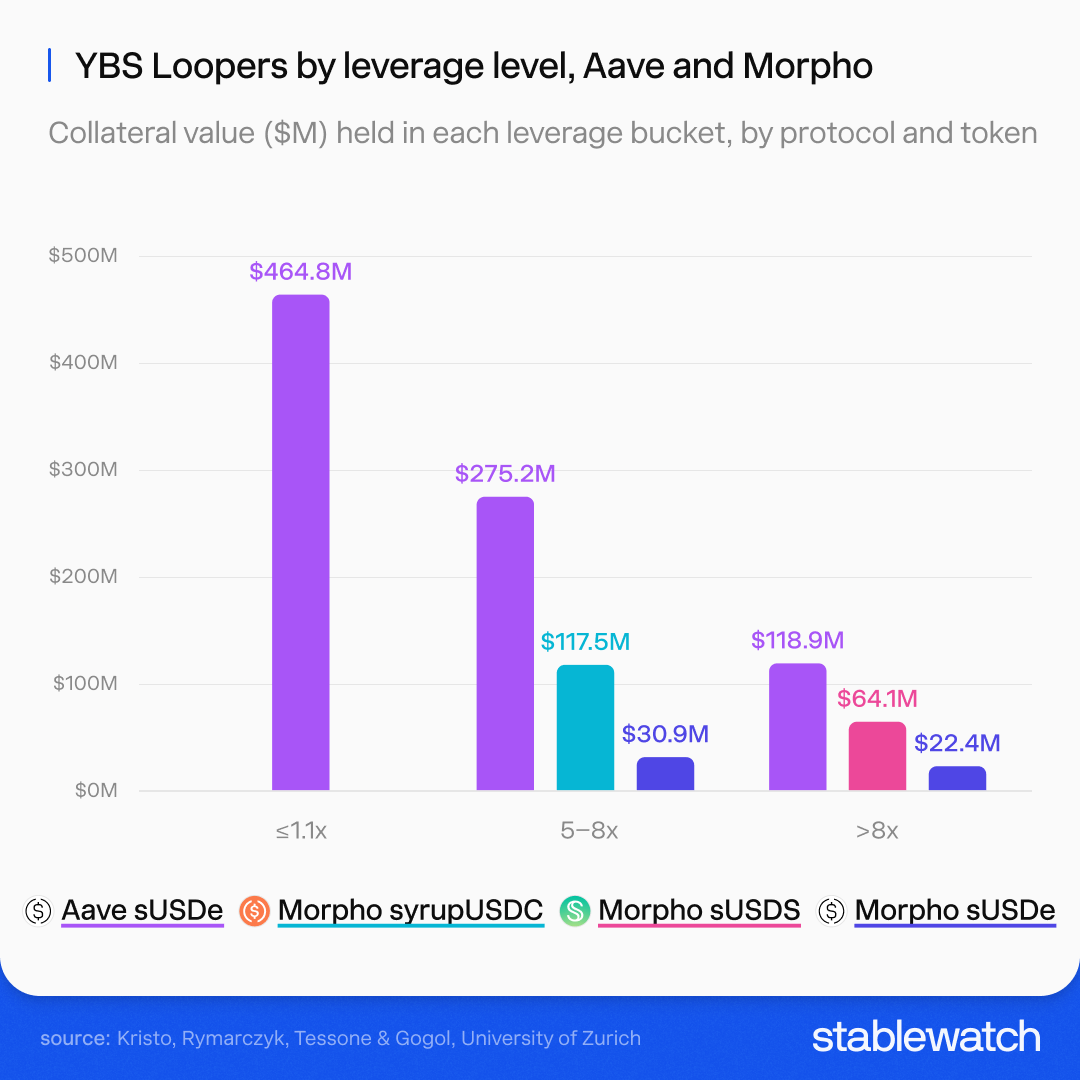
A chart showing the borrowers by leverage bucket on Aave and Morpho.
The difference becomes even more pronounced once leverage enters the picture.
On Aave, 83.7% of sUSDe borrowers (821 out of 981) use 1.1x leverage or less, together holding $464.8 million with little leverage. A much smaller group is at the other end: 26 borrowers in the 5–8x range hold $275.2 million, which is more than half the value of the low-leverage group, even though they make up only about 3% of the total. Another 48 borrowers above 8x hold $118.9 million.
On Morpho, most borrowers use 5x leverage or more across all three tokens: syrupUSDC has $117.5 million in the 5–8x range among 42 borrowers, and sUSDS has 60 borrowers above 8x with $64.1 million.
Since unused borrowing capacity does not earn a return on tokens that are designed to grow in value, the largest holders have every reason to use as much leverage as the protocol allows.
Among the 23 loopers in the dataset, certain kind of wallet activity, such as supplying, withdrawing, borrowing, or repaying, occurs on 14.8% of looper-days. However, leverage level changes on only 7.2% of those days (180 out of 2,506 looper-days). Most of the activity is related to moving capital in or out, not actually changing the leverage ratio.
On days when leverage changes, short-term LTV volatility in the preceding period is the best predictor of an upcoming adjustment, even more than the current carry spread. The actual leverage level at the time matters less. Overall, it suggests that leverage is set intentionally and only adjusted when market conditions shift enough to warrant it.
Concentrations of Loan Positions
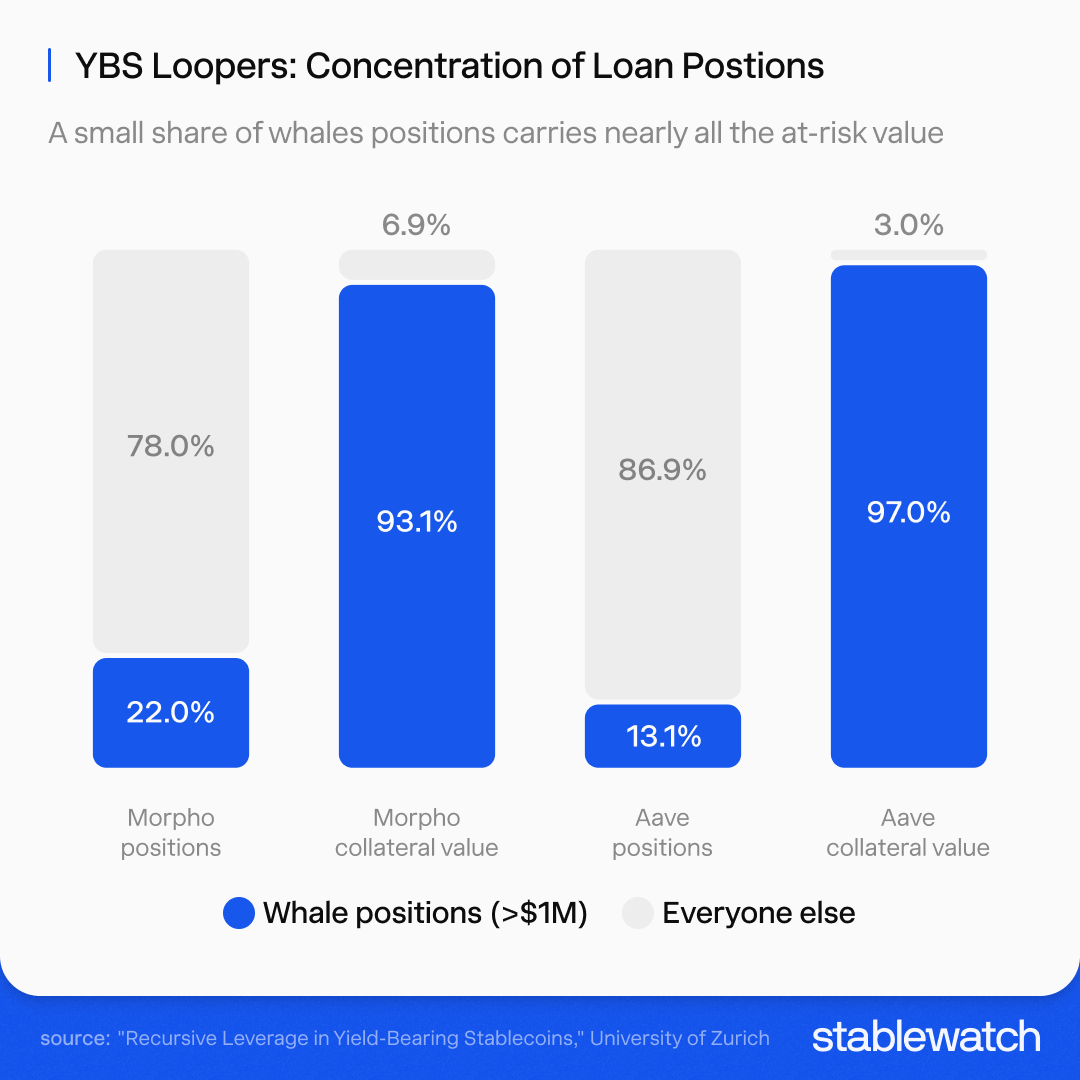
A chart showing the concentration of loan positions on Morpho and Aave.
YBS leverage is distributed differently across Aave and Morpho, but in both protocols, most of the risk is concentrated in a few large positions.
For Aave, 90.5% of sUSDe value backed by stablecoins ($531.1 million out of $587.1 million) is in the critical or high-risk band (health factor < 1.05). In that group, whale positions account for only 13.1% of the positions but hold 97.0% of the value at risk.
On Morpho, whale positions are 22.0% of the count but hold 93.1% of the $241 million at risk.
Since this pattern appears in both protocols, it seems to be a general whale looping strategy of YBS.
Oracle and YBS Peg Impact and Liquidation Risk
A small drop in YBS price could trigger large liquidations on both protocols, because Aave and Morpho use oracle-reported prices rather than a fixed peg.
On Aave, a 3–5% fall in sUSDe’s price would increase total liquidated collateral from $40 million to over $510 million.
On Morpho, each token reacts at different points: sUSDS starts liquidating with drops as small as 5%, reaching $60 million by a 10–11% drop; syrupUSDC stays steady until about 12%, then liquidates over $130 million between 12–18%; sUSDe increases more slowly and tops out at $55 million.
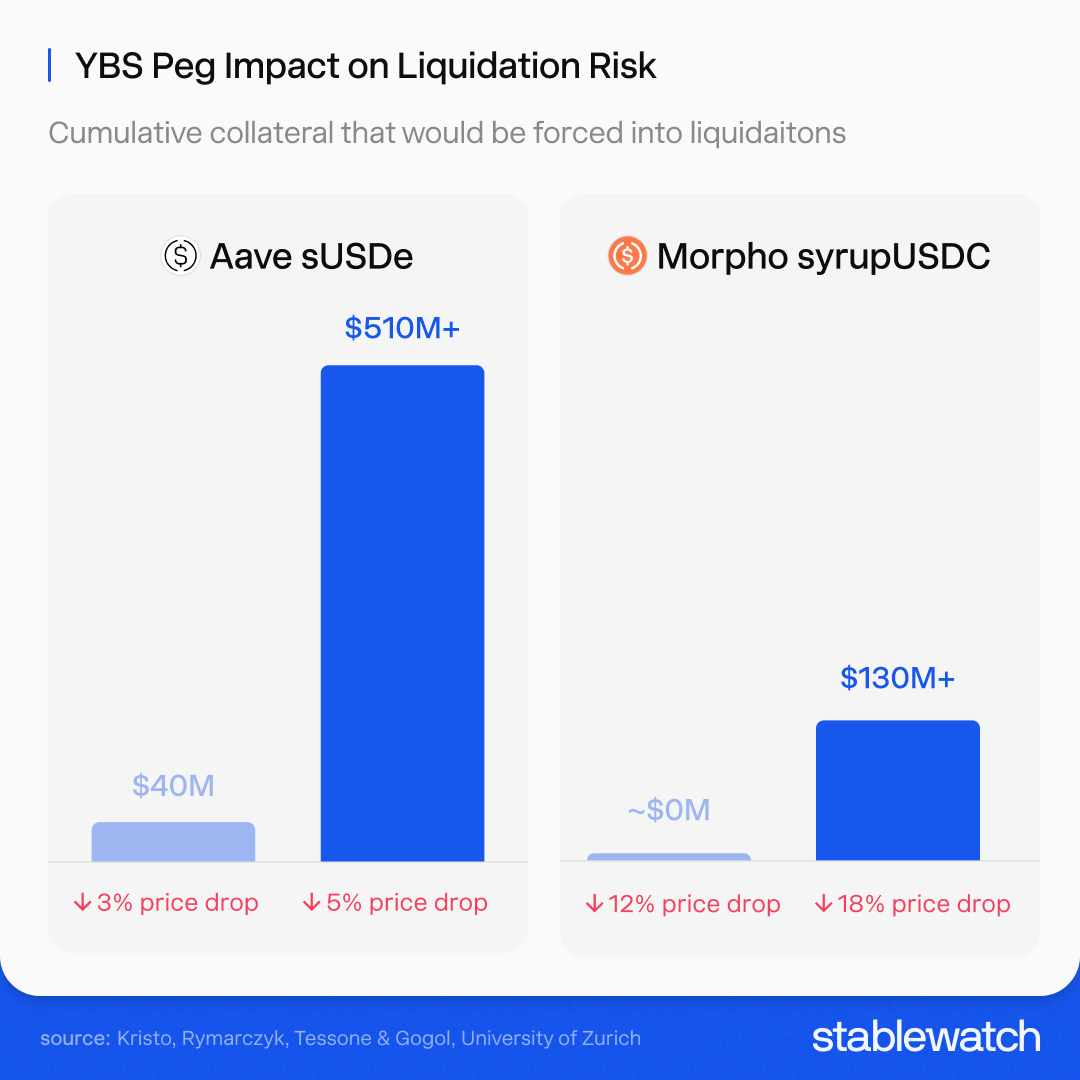
A chart showing the cumulative liquidatable collateral at the reported price-drop thresholds.
In the looper sample, 28.9% of looper-days had a health factor at or below 1.05, but none of these days ended in liquidation during the study period. The closest any position got to liquidation was a health factor of 0.998. This gap shows that yield-bearing stablecoins rarely lose value.
For example, from September 2025 to September 2026, Bitcoin’s price ranged from $59,000 to $125,000, with several days seeing drops of 5% or more, while syrupUSDC rose steadily from about $1.12 to $1.18 without any major drops. A big enough move to cause the stress scenario would likely come from an issuer failure, not normal market dynamics. This is why the earlier finding about risk concentration is important: if liquidations happen, they would affect a few large positions at once. The risk is low-probability but high-impact.
Whale Looper Behaviors
The two protocols differ significantly in how whales can exit under pressure.
On Aave, 18.5% of the 81 sUSDe whales have used flash loans, compared to 4.16% of all sUSDe holders. A flash loan allows a whale to unwind an entire looped position in a single transaction, right when a price drop would otherwise trigger liquidation.
On Morpho, none of the 41 whales across all three tokens have used a flash loan. Instead, they rely on regular, multi-step deleveraging if prices fall.
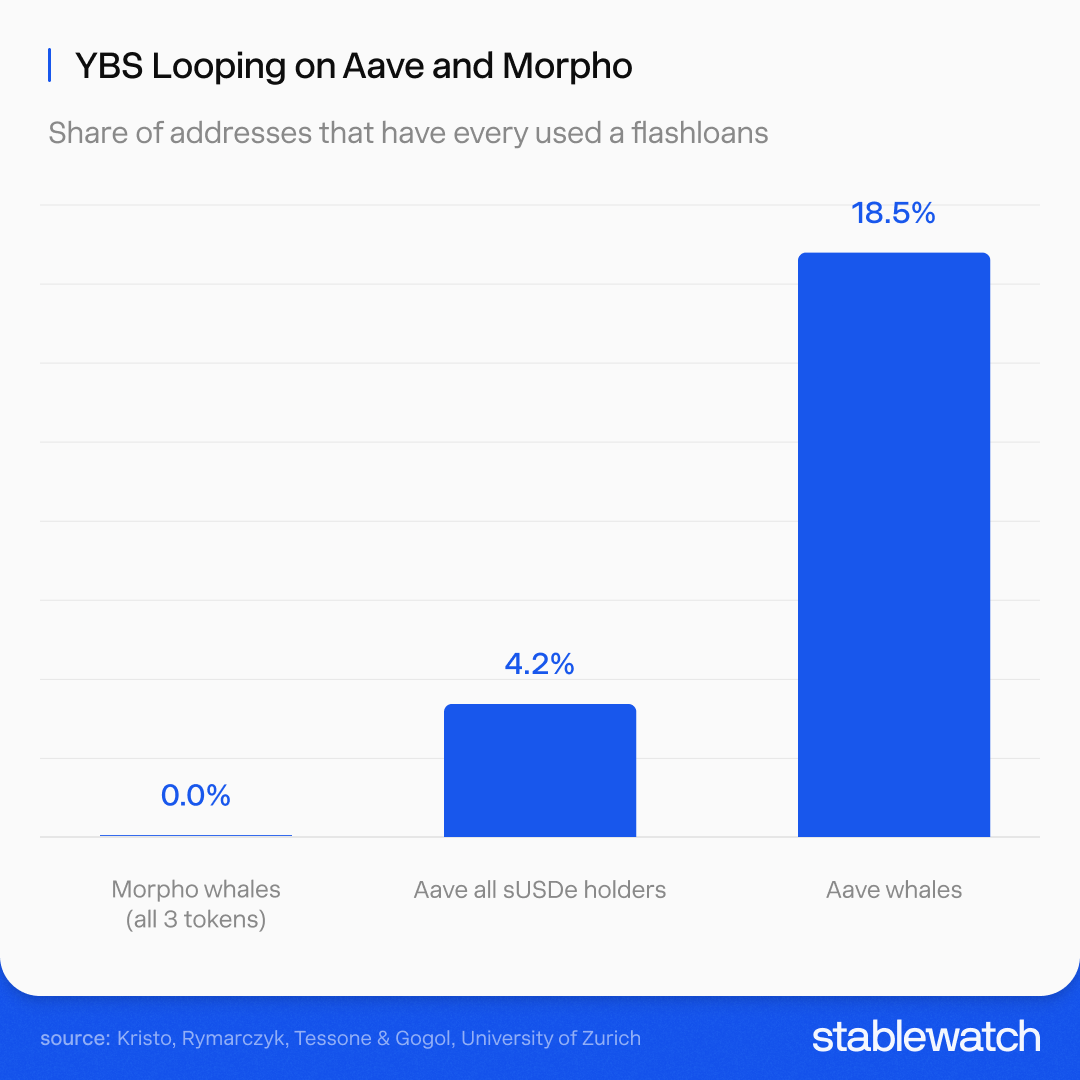
A chart comparing the share of addresses that have ever used a flash loan across Morpho whales, Aave whales, and all Aave sUSDe holders.
The protocols also differ in how they handle collateral when there is no active loan.
On Morpho, every whale position has an active borrow.
On Aave, most do not: 61.0% of whales and 69.4% of retail addresses supply sUSDe as collateral without borrowing against it. This suggests that much of the collateral is being held in reserve for future loans, rather than for active looping.
The Loop Like a Whale Checklist
The findings above suggest a practical checklist for anyone reviewing a looped position, whether you are the borrower or an allocator checking a vault.
Six checks help distinguish a managed loop from an unmanaged one:
Conclusion and Takeaways
A relatively small number of large borrowers account for much of the highly leveraged YBS exposure across Aave and Morpho. They run closer to LTV limits, rarely adjust their leverage once set, and account for the overwhelming majority of the value at risk in the event of a drop in YBS price.
So far, though, there have been no liquidations. The amount of collateral near the risk threshold is large enough that even a small price drop could trigger one.
For Protocol Risk Teams and YBS Designers
A few addresses are responsible for most of the extreme risk in each market. Tracking these addresses directly, rather than relying on average leverage statistics, provides a much clearer picture of how close the market is to its liquidation limit.
For Institutional Allocators Running or Evaluating a Loop
Carry spread does not always lead to profits, and leverage can increase losses just as much as gains. When reviewing a looped position, you should check the current spread and liquidation penalty, size your position based on the market’s liquidation LTV rather than a fixed leverage target, and consider the exit options available on the protocol. The Loop Like a Whale Checklist above is designed to help with this process.
For Depositors and Passive Holders of YBS Tokens
The stability of sUSDe, sUSDS, and syrupUSDC has so far prevented any liquidations of concentrated leverage positions. This is thanks to the low volatility of their underlying YBS pegs and oracle designs, but the risk from excessive leverage remains. If you are a depositor checking a yield-bearing stablecoin vault, you should ask what portion of the collateral is close to its liquidation threshold, using the same health-factor approach discussed in this report.
Disclosure: Krzysztof advises institutional allocators, including Nook, on DeFi and vault due diligence, and advises fund managers and tokenization issuers, including Obligate, on distribution. This report is for research and educational purposes only and does not constitute financial, investment, legal, or tax advice. This report draws on the empirical findings of “Recursive Leverage in Yield-Bearing Stablecoins: Proof-of-Concept and Empirical Analysis” by Igli Kristo, Dawid Rymarczyk, Claudio J. Tessone, and Krzysztof M. Gogol, University of Zurich, 2026.